
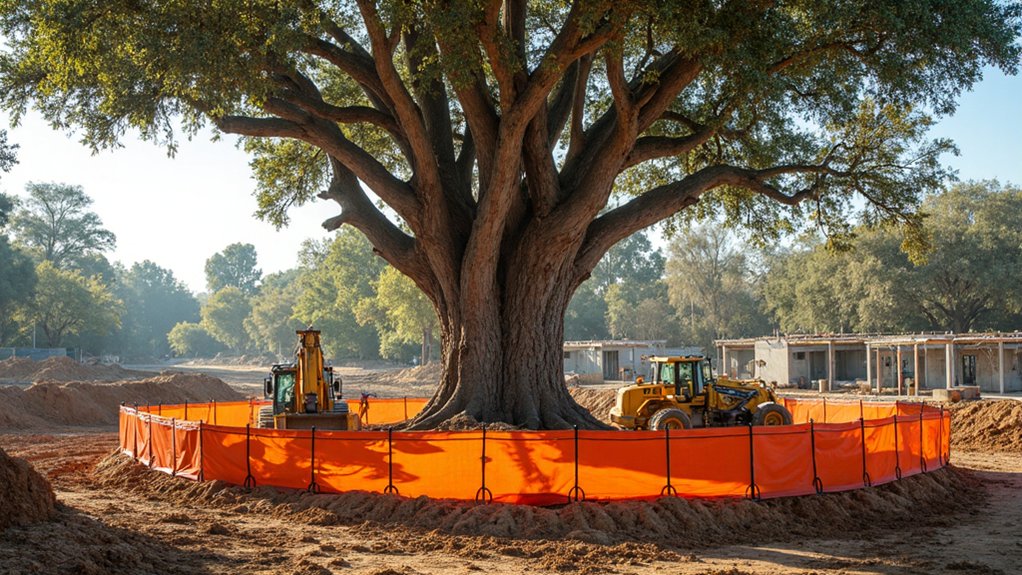
Did you know that construction activities destroy approximately 40% of existing trees on development sites? You’re facing a critical challenge when balancing development needs with environmental stewardship. The mature trees on your property represent decades of growth and provide irreplaceable ecological benefits, yet they’re incredibly vulnerable to construction damage. What you might not realize is that most tree loss isn’t intentional—it happens because you haven’t implemented the right protective strategies from day one.
Key Takeaways
- Conduct comprehensive tree inventories using certified arborists to assess species, condition, and structural integrity before construction begins.
- Establish protective zones extending 1.5 times the canopy radius with sturdy fencing and clear “No Entry” signage.
- Prohibit all construction activities, equipment operation, and material storage within designated tree protection areas.
- Prevent soil compaction by limiting vehicle traffic and using temporary road mats to distribute weight properly.
- Implement ongoing monitoring protocols and adaptive management strategies to maintain tree health throughout the construction process.
Assessing Tree Health and Risk Before Construction Begins
Success in tree preservation hinges on thorough pre-construction assessment. You’ll need to evaluate each tree’s species, age, and overall condition to determine preservation viability. Focus on identifying trees with well-developed root systems and structurally sound trunks and branches, as they’re most likely to survive construction impacts.
Assess tree health by examining canopy density, bark condition, and signs of disease or decay. Map the root zone for each specimen, typically extending 1.5 times the canopy radius. This information helps establish appropriate protection zones around valuable trees.
Don’t overlook hazardous trees that pose safety risks or those in poor condition. Remove these before construction begins. Additionally, evaluate soil structure and drainage patterns, as these environmental factors profoundly impact long-term survival and determine which trees warrant preservation efforts.
Conducting Comprehensive Tree Inventories for Development Projects
Before you can make informed decisions about which trees to preserve, you’ll need to conduct a thorough inventory that systematically documents every tree on your development site. Your tree inventory should record each tree’s species, diameter, height, condition, and exact location using GPS coordinates or surveying methods.
Hire certified arborists to assess each tree’s structural integrity, disease presence, and root system health. They’ll evaluate how construction activities might impact different species and determine which trees are viable candidates for tree preservation. Document crown spread, trunk defects, and soil conditions around each specimen.
This detailed data becomes the foundation for your tree protection plan, enabling you to design construction layouts that avoid critical root zones and implement appropriate safeguarding measures for retained trees.
Developing Effective Tree Preservation Plans
Once you’ve completed your thorough tree inventory, you’ll transform that data into an actionable tree preservation plan that serves as your construction project’s roadmap for protecting valuable trees. Your plan should establish clear protective zones around each retained tree, typically extending beyond the drip line to safeguard critical root zones from compaction and damage.
You’ll need to specify construction restrictions within these areas, including prohibited activities like material storage, vehicle parking, and soil disturbance. Your tree preservation plans must include detailed fencing specifications, installation requirements, and monitoring protocols throughout construction phases.
Don’t forget to incorporate mitigation measures for unavoidable impacts, such as root pruning procedures and supplemental watering systems. Effective tree protection requires ongoing health assessments and adaptive management strategies to guarantee your preserved trees survive construction activities.
Establishing and Maintaining Tree Protection Zones
While your preservation plan provides the blueprint, establishing physical tree protection zones transforms those guidelines into tangible barriers that guarantee your trees throughout construction. You’ll need to create protective barriers extending at least to the drip line, though larger trees may require additional buffer space. Calculate the critical root zone by measuring one foot of radius per inch of trunk diameter at breast height.
Install sturdy fencing or barriers before any construction equipment enters the site. Orange safety fencing won’t suffice – use wooden boards or chain-link panels that construction equipment can’t easily breach. Mark these zones clearly with signage indicating “Tree Protection Area – No Entry.” Regular monitoring verifies barriers remain intact and prevents soil compaction, grade changes, or material storage within protected zones.
Installing Proper Protective Fencing Around Retained Trees
Effective tree protection depends on installing robust fencing that can withstand the rigors of an active construction site. You’ll need to position sturdy, temporary barriers at the drip line or beyond each tree’s critical root zone. Use high-visibility materials like orange plastic netting supported by steel posts to create unmistakable boundaries.
Your fenced area must completely enclose the root protection zone, prohibiting all construction activity, equipment, and materials storage within it. Never attach anything to the protected trees themselves, as this damages bark and invites infection.
- Install fencing at or beyond the tree’s drip line to protect the entire root system
- Use high-visibility materials like orange netting with steel posts for maximum durability
- Maintain complete enclosure with zero construction activity permitted inside
- Communicate boundaries clearly to all workers and enforce restrictions consistently
Preventing Soil Compaction During Construction Activities
Beyond establishing protective barriers, you must address one of the most destructive threats to tree health during construction: soil compaction. Heavy equipment crushes soil particles together, creating dense layers that prevent your tree’s root system from accessing essential water and nutrients. This damage can preserve long-term harm even after construction ends.
Limit all vehicle traffic and material storage within designated tree protection zones. When access is unavoidable, use temporary road mats or permeable surfaces to distribute weight across the root zone. These materials prevent direct soil compression while allowing necessary construction activities.
Implement periodic soil aeration within protected areas using specialized equipment. This process breaks up compacted layers and restores soil structure, ensuring your retained trees maintain healthy root function throughout the construction process.
Managing Grade Changes and Drainage Around Trees
When construction plans involve changing the existing ground level, you’ll face one of the most challenging aspects of tree preservation. Grade changes can severely damage or kill existing trees by disrupting their root systems and altering drainage patterns around the root zone.
Key strategies for Preserving Trees during grade modifications:
- Build protective retaining walls when grading changes are planned to maintain existing soil levels around tree roots
- Preserve topsoil from areas where new landscaping will be installed after construction
- Maintain proper distances when trenching near trees – keep trenches one foot away for every inch of trunk diameter
- Plan selective pruning of construction-impacted roots and branches to help trees survive the process
You’ll need to make informed decisions about which trees can realistically survive proposed grade changes around their root zones.
Monitoring Tree Health Throughout the Construction Process
Construction projects can drag on for months or years, making ongoing tree health monitoring critical for catching problems before they become irreversible. You’ll need regular inspections by a certified arborist to identify issues early and maintain healthy trees throughout the process. Monitor soil moisture levels around the tree and provide supplemental watering when necessary to reduce stress on the tree’s roots.
Watch for distress signs like wilting leaves, dieback, or fungal growth that require immediate intervention. Document tree condition through photographs to track any changes during construction. You should preserve and protect your investment by maintaining detailed logs of all tree-related activities, inspections, and treatments. This documentation guarantees transparency and accountability, giving you concrete evidence of your preservation efforts.
Post-Construction Tree Care and Maintenance Strategies
Once construction wraps up, your preserved trees enter a recovery phase that demands targeted care strategies to address the stress they’ve endured. Construction activities can severely impact a tree’s roots and surrounding soil, making thorough post-construction maintenance essential to preserve trees long-term.
Key post-construction care strategies include:
- Monitor tree health regularly – Watch for signs of decline, disease, or structural issues that may emerge months after construction
- Address soil compaction around a tree – Restore proper drainage and aeration to support root recovery
- Provide supplemental watering and fertilization – Help trees recover from construction stress and nutrient depletion
- Implement proper pruning techniques – Remove damaged branches and address any tree damage from construction activities
This proactive approach guarantees your urban forest remains healthy and viable for years to come.
Understanding Municipal Tree Preservation Ordinances and Regulations
Why do some construction projects seamlessly preserve mature trees while others result in widespread canopy loss? The answer often lies in municipal tree preservation ordinances that regulate how you must protect existing trees during development. These regulations, found in 90% of surveyed communities, establish specific requirements for safeguarding trees during construction phases.
You’ll find these ordinances typically mandate protection zones around tree’s roots, require permits for tree removal, and specify preservation methods during building activities. They’re designed to balance your development needs with environmental protection, though enforcement can be challenging.
Understanding your local tree preservation regulations is indispensable before breaking ground. These ordinances directly impact how you plan construction activities around mature trees, potentially affecting project timelines, costs, and design modifications to ensure compliance.
Frequently Asked Questions
How to Protect Trees During Construction?
You’ll start with a thorough tree assessment process, then establish barriers for equipment storage placement away from roots. Prevent soil compaction by restricting access zones, and apply proper tree pruning techniques under arborist guidance.
How Much Area Around a Tree Should Be Protected During a Construction Event?
You should protect the critical root zone area extending to the tree’s drip line. Install tree preservation fencing around this perimeter for effective drip line protection and construction traffic control during your project.
How to Protect an Old Tree?
You’ll protect old trees by implementing proper pruning techniques, establishing consistent watering schedule adjustments, applying effective soil aeration methods, and installing bark protection measures. Don’t forget mulching and regular health monitoring for ideal longevity.
How to Treat Construction Damage to Tree Roots?
You’ll evaluate soil compaction while others ignore it, monitor tree health when crews rush past, mitigate root damage as machinery pounds nearby, and manage construction traffic that threatens survival—your vigilance saves trees.
Conclusion
You’ll discover that successful tree preservation isn’t just about following protocols—it’s about understanding that trees are living infrastructure investments. When you’ve properly protected a mature oak through construction, you’re not just saving a tree; you’re preserving decades of carbon storage, cooling shade, and property value. Your commitment to tree preservation today directly determines whether future generations will enjoy established canopies or struggle with barren, newly planted landscapes that’ll take decades to mature.