
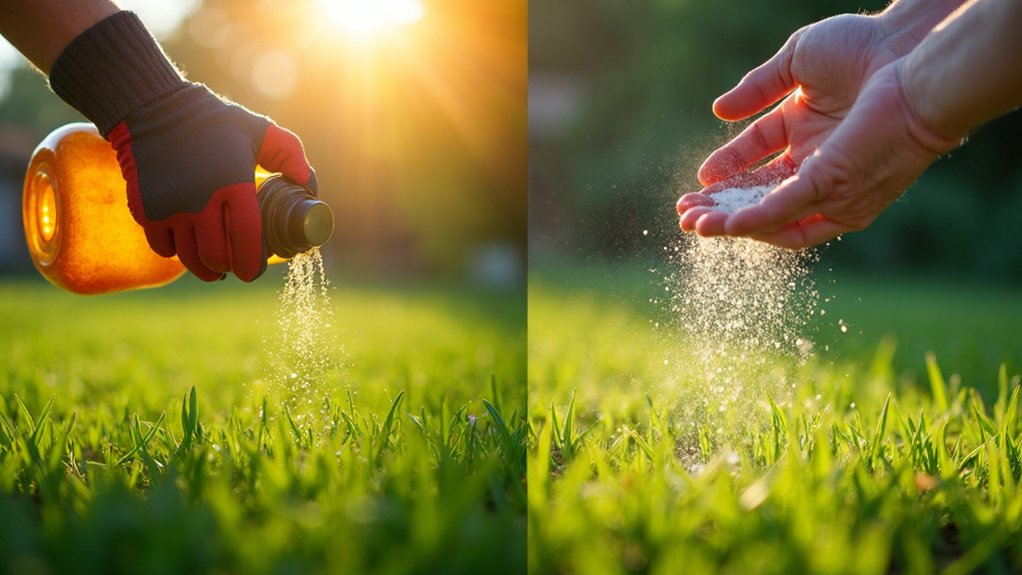
When Sarah noticed her tomato plants showing yellow leaves mid-July despite her spring granular application, she wondered if switching to liquid fertilizer might’ve prevented the problem. You’ve likely faced similar timing dilemmas with your own garden—questioning whether your current fertilizer choice truly matches your plants’ needs. The debate between liquid and granular fertilizers isn’t just about convenience; it’s about understanding how each method delivers nutrients and impacts your garden’s success throughout the growing season.
Key Takeaways
- Granular fertilizers provide slow-release, season-long feeding with fewer applications, making them ideal for maintenance programs.
- Liquid fertilizers deliver immediate nutrient availability and excel at addressing mid-season deficiencies requiring quick results.
- Granular application is more cost-effective for large areas but requires proper spreader calibration and thorough watering.
- Liquid fertilizers offer precise, targeted application and can be tank-mixed with herbicides or pesticides for efficiency.
- Combining both methods creates optimal nutrition: granular for base feeding and liquid for supplemental or corrective treatments.
Understanding Granular Fertilizers: Composition and Characteristics
When you examine granular fertilizers closely, you’ll notice they come as small, multi-colored pellets designed to release nutrients gradually as soil moisture and microbial activity break them down. This slow-release characteristic means you won’t need constant reapplications throughout the growing season, making granular options convenient for busy gardeners.
However, you’ll encounter some spatial challenges with granular fertilizers. There’s often a physical gap between where the pellets sit and where your plant roots can access the nutrients. This distance can limit immediate nutrient availability, especially for immobile elements like phosphorus that don’t move easily through soil.
You can overcome this limitation by “sparging” – applying liquid fertilizer alongside granular products to provide immediate nutrient uptake while maintaining long-term feeding benefits.
Understanding Liquid Fertilizers: Composition and Characteristics
Unlike their granular counterparts, liquid fertilizers arrive as highly concentrated, water-soluble nutrient solutions that you’ll dilute before application. This liquid fertilizer format offers immediate nutrient availability since the nutrients are already dissolved and plant-ready.
You’ll find these formulations typically contain higher percentages of nitrogen, phosphorus, and potassium compared to granular options. Liquid fertilizers provide versatile application methods that enhance how nutrients are absorbed:
- Foliar spray application – Apply directly to leaves for rapid uptake through leaf surfaces
- Soil drench method – Pour around root zones for traditional soil absorption
- Tank mixing capability – Blend with pesticides or herbicides for efficient combination treatments
This flexibility makes liquid fertilizers particularly valuable when you need quick nutrient delivery or want to streamline your application process.
Advantages and Disadvantages of Granular Fertilizers
Granular fertilizers offer a completely different approach to plant nutrition, arriving as small, multi-colored pellets that break down gradually in your soil. This slow-release characteristic means you’ll enjoy season-long feeding without constant reapplications, making granular fertilizer more cost-effective when purchased in bulk compared to liquid alternatives.
However, you’ll face some trade-offs with this convenience. Application consistency becomes challenging since granular fertilizer distributes less evenly than liquid options, potentially creating fertilizer striping if you’re not careful with your broadcast or drop spreader technique. The higher salt content can also inhibit new root development, which may concern you if you’re establishing young plants or seeding areas. Despite these drawbacks, many gardeners appreciate the set-and-forget nature of granular formulations.
Advantages and Disadvantages of Liquid Fertilizers
Liquid fertilizers deliver nutrients directly to your plants’ root systems, offering immediate absorption that makes them particularly valuable when you need quick results. They’re perfect for addressing mid-season nutrient deficiencies and can be foliar applied for faster uptake. You’ll find them convenient to combine with herbicides or pesticides in a single application.
However, liquid fertilizers come with notable drawbacks:
- Higher costs – They’re more expensive than granular options and require frequent reapplications
- Storage challenges – Shorter shelf-life means you can’t stockpile them long-term
- Application risks – Improper use can cause fertilizer burn or trigger excessive growth that weakens root development
While liquid fertilizers excel at delivering quick nutrition, weigh these disadvantages against your specific lawn care needs and budget.
Application Methods and Techniques for Each Type
When choosing between fertilizer types, understanding proper application techniques becomes essential for achieving ideal results. To apply granular fertilizer effectively, you’ll need a rotary or drop spreader that guarantees even distribution across your lawn or garden. Proper calibration prevents over- or under-application, making this step indispensable for success. After spreading, you must water thoroughly to help nutrients penetrate the soil.
When you apply liquid fertilizer, use a hose-end or backpack sprayer for targeted, controlled application. This type of fertilizer offers immediate nutrient availability, making it perfect for quick plant response. You can combine both methods by applying granular fertilizer first, then following with periodic liquid applications. This all-encompassing approach creates a balanced nutrient program that maximizes plant growth potential.
Nutrient Release Patterns: Controlled vs. Quick-Release
Understanding nutrient release patterns helps you make informed decisions about fertilizer timing and plant health outcomes. Slow-release granular fertilizer provides steady nutrition over 6-8 weeks, promoting sustained lawn and plant health through consistent feeding. Quick-release liquid fertilizers deliver immediate nutrient availability, creating rapid growth surges perfect for correcting deficiencies.
Nutrient Release Patterns Impact:
- Application frequency – Granular fertilizers need only 1-2 applications yearly, while liquids require more frequent feeding
- Plant response timing – Liquids provide instant results as starter fertilizers, granulars offer long-term nourishment
- Nutrient delivery method – Granulars typically blend quick and slow-release components for initial boost plus sustained feeding
You’ll find liquid fertilizers work best for immediate corrections, while granular options excel at maintaining consistent plant nutrition throughout growing seasons.
Choosing the Right Fertilizer Type for Your Specific Needs
Selecting between liquid and granular fertilizers requires matching your fertilizer type to your specific gardening goals and plant conditions. For established lawns needing long-term nutrition, granular fertilizers deliver sustained nutrient release that supports ongoing health. However, if you’re starting new grass or need quick results, liquid fertilizers provide immediate, uniform coverage without risking damage to delicate growth.
Consider your lawn’s needs when timing applications. Granular fertilizers work best for perennial plants like shrubs and mature grass that benefit from steady nutrition. Liquid fertilizers excel for annuals and situations requiring rapid nutrient boosts. You’ll also want to factor in application convenience and your maintenance schedule. The right choice depends on balancing your specific plants’ growth stage, nutrient requirements, and desired timeline for results.
Frequently Asked Questions
What Method of Fertilizer Application Is the Most Effective?
You’ll find that proper fertilizer incorporation techniques matter most for effectiveness. Your fertilizer application timing should match your lawn’s needs, while ensuring ideal soil nutrient absorption through watering granular types or directly applying liquid fertilizers.
What Is the Best Way to Apply Liquid Fertilizer?
Studies show liquid fertilizers absorb 8-10 times faster than granular. You’ll achieve uniform coverage by ensuring proper dilution according to label instructions and maintaining consistent walking speed for even distribution across your lawn.
What Is the Best Way to Apply Granular Fertilizer?
You’ll achieve even application by calibrating your spreader properly and walking in overlapping rows. Time applications during active growth periods, and choose formulations that target nutrient needs for precise feeding results.
What Is the Best Method of Applying Organic Fertilizer?
Studies show organic matter increases soil water retention by 20%. You’ll get best results timing soil amendment with compost application before planting season. Work organic matter incorporation into existing soil for ideal nutrient release.
Conclusion
You’ll find that neither fertilizer type claims complete superiority over the other. Your garden’s success doesn’t depend on choosing sides, but rather on understanding when each option serves your plants’ appetites best. Think of granular as your steady companion for the long haul, while liquid becomes your quick-response partner. You’re not settling for less when you blend both approaches—you’re simply orchestrating a more complete nutritional symphony for your growing space.