
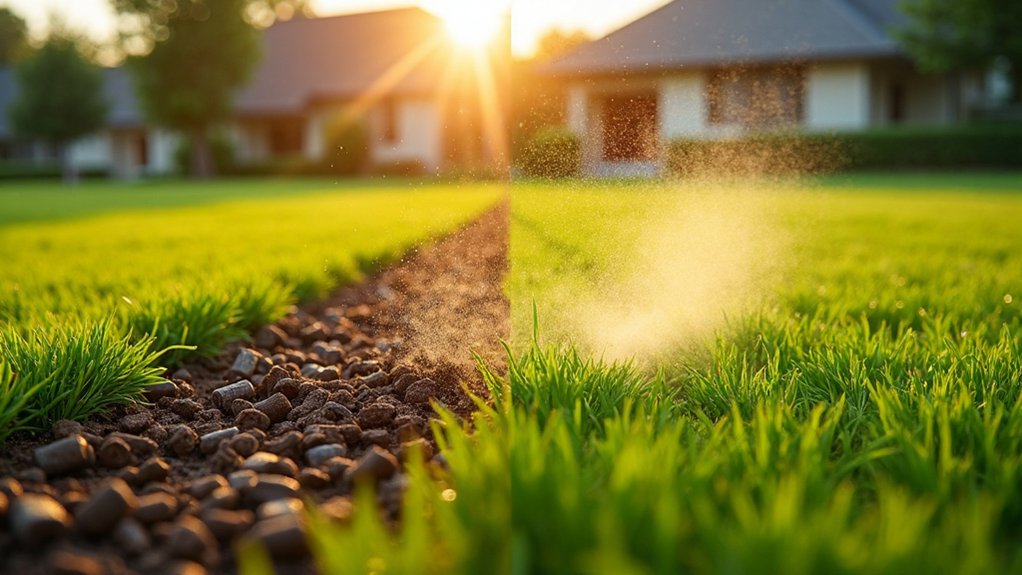
You’ve probably noticed your lawn struggling with water pooling and poor growth just as you’re researching aeration solutions—what timing. You’re likely wondering whether liquid or core aeration will solve your soil compaction problems more effectively. Both methods promise to improve your lawn’s health, but they work in completely different ways and deliver varying results. The choice between these two approaches isn’t straightforward, and making the wrong decision could waste your time and money.
Key Takeaways
- Core aeration mechanically removes soil plugs for immediate compaction relief, while liquid aeration chemically breaks down soil structure gradually.
- Liquid aeration penetrates deeper throughout the root zone and provides long-term soil health improvements with repeated applications.
- Core aeration excels at tackling severe soil compaction and thatch buildup through direct mechanical intervention and microbial activity.
- Combining both methods maximizes results by delivering immediate relief from core aeration and sustained improvements from liquid treatment.
- Soil conditions, compaction severity, and lawn obstacles determine which method works better for your specific lawn needs.
What Is Lawn Aeration and Why Does Your Lawn Need It?
While your lawn might look lush on the surface, compacted soil beneath can slowly strangle your grass’s root system. Lawn aeration creates pathways in your soil, allowing air, water, and nutrients to penetrate deeper where your grass needs them most.
Soil compaction happens naturally over time from foot traffic, heavy equipment, and weather conditions. When your soil becomes compacted, your grass roots can’t expand properly, limiting their ability to absorb essential nutrients and water. This restriction leads to weak, shallow root systems that struggle to support healthy growth.
Core aeration involves removing small plugs of soil to relieve this compression. You’ll know your lawn needs aeration when you notice water pooling after rain, bare spots developing, or soil that feels hard underfoot.
Understanding Core Aeration: Process and Benefits
Core aeration transforms your lawn through a straightforward mechanical process that delivers lasting results. This lawn aeration method uses specialized equipment to punch holes throughout your soil, physically removing soil plugs to combat soil compaction. You’ll immediately notice improved water infiltration as these openings create direct pathways for moisture to reach deeper soil layers.
The process substantially enhances nutrient absorption by allowing fertilizers and organic matter to penetrate compacted areas. Your grass experiences accelerated root growth as roots expand into the newly created spaces and improved soil ecosystem. Core aeration also tackles thatch buildup by introducing beneficial microorganisms that break down organic debris naturally. This mechanical approach provides measurable improvements to soil structure, making it easier to maintain a healthy lawn year-round.
Understanding Liquid Aeration: Process and Benefits
Unlike mechanical methods that physically pierce your soil, liquid aeration uses specially formulated solutions to chemically break down compacted soil structure from within. These liquid lawn aerators penetrate deeper than traditional methods, allowing the solution to alleviate soil compaction throughout your lawn’s root zone.
The process delivers multiple benefits that improve your lawns:
- Enhanced Water Absorption – The solution breaks down compacted particles, creating pathways for better moisture penetration
- Deeper Root Development – Loosened soil allows roots to grow deeper, establishing a stronger foundation for your grass
- Long-term Soil Health – Each application compounds previous treatments, continuously working to improve soil structure and oxygen circulation
This non-invasive approach covers your entire lawn surface, including hard-to-reach areas around obstacles, while promoting sustained soil health improvements over time.
Comparing Effectiveness: Core Aeration vs. Liquid Aeration
When choosing between core and liquid aeration methods, you’ll find each approach excels in different scenarios based on your lawn’s specific needs. Core aeration delivers immediate results for severely compacted soil by physically removing plugs and creating channels for air, water, and nutrients to reach your root system. However, liquid aeration offers superior coverage around obstacles and structures while gradually improving soil structure and porosity over time through repeated applications.
For heavily compacted soil with excessive thatch buildup, core aeration provides faster relief from soil compaction. Meanwhile, liquid aeration’s compounding effects continuously enhance soil health with each treatment. The most effective lawn aeration strategy often combines both methods—starting with core aeration for immediate results, then maintaining improvements with liquid aeration applications.
Which Aeration Method Is Right for Your Lawn?
Determining the ideal aeration method for your lawn requires evaluating several key factors that directly impact which approach will deliver the best results. Your soil conditions play the primary role in selecting between core aeration and liquid aeration for optimal lawn health.
Consider these essential factors when choosing your lawn aeration method:
- Compaction severity – Core aeration works best for heavily compacted soils, while liquid aeration suits moderately compacted areas
- Timeline expectations – Core aeration provides immediate relief from soil compaction, whereas liquid aeration offers gradual, long-lasting improvements to soil structure
- Lawn accessibility – Liquid aeration reaches tight spaces around obstacles, but core aeration handles severe compaction more effectively
For lawns with significant soil aeration needs, combining both methods maximizes results. Consulting a lawn care professional guarantees you’ll select the most suitable approach for your specific soil conditions.
Professional Aeration Services vs. DIY Approaches
Most homeowners face a pivotal decision between tackling lawn aeration themselves or hiring professional services. While DIY approaches might seem cost-effective, they often result in inadequate treatment of compacted lawns or potential damage to your lawn’s surface. Professional aeration service providers possess specialized equipment and expertise to determine whether core aeration might be ideal or if liquid aeration products better suit your soil conditions.
Property owners benefit greatly from professional assessment of the soil in your yard. Experts can identify the most effective lawn aeration method based on your specific needs. This guarantees your lawn receives proper treatment without risk of harm. Professional aeration helps maintain consistent results, particularly important since aeration helps restore soil health annually. The investment in professional services ultimately protects your lawn’s long-term health and appearance.
Frequently Asked Questions
Which Type of Aeration Is Best?
You’ll find the best aeration depends on your lawn’s needs. Core aeration excels at compaction alleviation and thatch reduction, while liquid aeration provides superior soil structure enhancement and microbial activity boost for long-term results.
What Are the Cons of Liquid Aeration?
Don’t put all your eggs in one basket—liquid aeration has high cost, limited effectiveness against severe soil compaction, poor moisture penetration, and it’s surface treatment only with uneven application, making it ineffective for thatch removal.
What Is the Best Method to Aerate Your Lawn?
You’ll achieve best lawn health promotion by combining both methods. Core aeration tackles compacted soil penetration and surface thatch buildup immediately, while liquid aeration provides long-term soil porosity enhancement and microbial activity stimulation.
What Is the Best Method to Improve Soil Aeration?
Picture your lawn’s roots breathing freely through loose, rich earth. You’ll achieve ideal soil compaction reduction through combining core and liquid aeration methods, promoting microbial activity, enhancing nutrient absorption, and stimulating root growth for superior grass health enhancement.
Conclusion
You’ve explored both aeration methods, and now it’s time to choose your weapon in the battle against soil compaction. Whether you’re wielding the immediate sword of core aeration or the gradual elixir of liquid treatment, you’ll transform your lawn from a medieval wasteland into thriving turf. Don’t let compacted soil hold your grass hostage—take action with the method that matches your lawn’s specific needs and watch it flourish.