
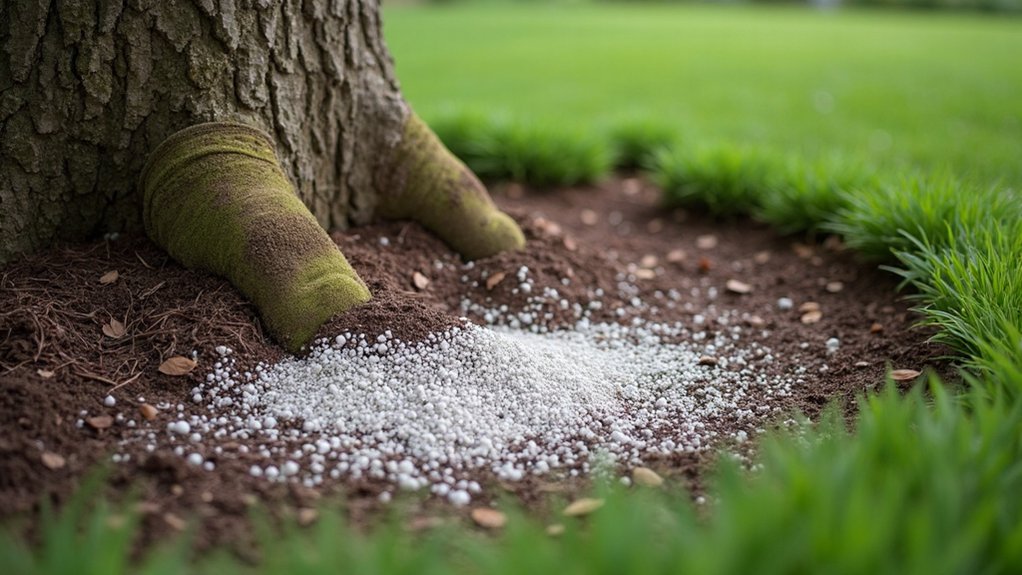
Picture the tangled web of roots beneath your feet, where tree roots and grass compete in an underground battle for every available nutrient. You’ve likely noticed your trees looking stressed despite regular lawn fertilizing, or perhaps your shrubs aren’t thriving as expected. This silent competition happens in the critical root zone, where dense turf grass often wins the nutrient game, leaving your valuable woody plants struggling. Understanding this hidden warfare will transform how you approach landscape nutrition.
Key Takeaways
- Apply mulch around trees to reduce grass competition and improve soil moisture retention in the critical root zone.
- Focus fertilizer application from trunk to drip line where most fine, absorptive roots are located in upper soil layers.
- Use slow-release or organic fertilizers to provide gentle, consistent nutrition without overwhelming competing grass roots.
- Time fertilization for late summer/early fall when roots actively absorb nutrients before grass becomes dormant.
- Test soil pH to ensure 6.0-7.0 range for optimal nutrient availability and reduced competition effects.
Understanding Root Zone Competition in Landscape Settings
Two critical factors determine whether your trees and shrubs thrive in a landscape setting: root zone competition and resource availability. Your trees and shrubs develop extensive, shallow root systems that extend well beyond their canopy, creating competition zones with nearby landscape plants. Turf grass presents the biggest challenge, as its dense root system aggressively competes for soil moisture and disrupts nutrient absorption. This competition often leads to nutrient deficiency in your trees and shrubs, weakening their overall health. During lawn maintenance, you risk damaging these critical root systems, further compromising tree care efforts. Applying mulch around your plants reduces grass competition while improving soil moisture retention, giving your root zone the advantage it needs for ideal nutrient absorption.
Identifying Critical Areas Around Trees and Shrubs
Where exactly should you focus your fertilizing efforts to maximize tree and shrub health? You’ll want to target the critical root zone, which extends from the trunk out to the drip line where branches end. This area contains most of your plants’ fine, absorptive roots within the upper 12 inches of soil. These tree roots and shrub root systems are where nutrients get absorbed most efficiently, making this zone your primary fertilizer application area.
The critical root zone is extremely sensitive to disturbance, so you’ll need to protect it from compaction and competition. Avoid digging or adding heavy soil amendments that could cause root damage. Instead, apply fertilizer and mulch gently within this zone to promote healthy growth while preserving the delicate root structure your plants depend on.
Selecting Slow-Release and Organic Fertilizer Options
Since trees and shrubs benefit from consistent, gentle nutrition rather than sudden nutrient surges, you’ll want to choose slow-release or organic fertilizers for your feeding program. These options deliver essential nutrients gradually, preventing nutrient deficiencies while protecting delicate feeder roots from chemical burn.
Consider these excellent slow-release and organic fertilizer choices:
- Compost and aged manure – boost organic matter content while providing balanced nutrition
- Bone meal and blood meal – supply phosphorus and nitrogen without overwhelming plants
- Sulfur-coated or polymer-coated urea – offer controlled slow-release nitrogen for steady growth
- Organic granular blends – combine multiple nutrient sources for all-encompassing feeding
Apply these fertilizers around the drip line where active feeder roots concentrate. This approach strengthens plants against drought stress and air pollution while avoiding excessive vegetative growth that attracts pests.
Proper Application Timing for Maximum Nutrient Uptake
Choosing the right fertilizer means nothing if you apply it at the wrong time. Trees and shrubs absorb nutrients most efficiently during late summer and early fall when roots actively uptake essential elements. You’ll achieve supreme nutrient absorption by timing fertilizer applications when woody plants can best utilize nitrogen and other nutrients directly.
Early spring represents another ideal window before new growth emerges, allowing trees growing in your landscape to access fertilizer evenly distributed into the soil. Avoid fertilizing during drought or extreme heat to prevent plant stress and injury.
Consider dividing your total nitrogen application throughout the growing season rather than single-dose fertilizing. This method supports plant growth while preventing high fertilizer concentrations that could damage root systems. Your tree or shrub’s natural growth cycle should guide timing decisions for maximum nutrient uptake efficiency.
Strategic Placement Techniques to Minimize Root Damage
When fertilizing trees and shrubs, you’ll protect delicate root systems by applying nutrients in a strategic circular pattern that extends from the trunk to the dripline and beyond. This approach guarantees your entire root system receives adequate nutrition while preventing damage to shallow, fibrous roots.
Follow these strategic placement techniques:
- Create holes 6-12 inches deep using a soil probe, spacing them 2-3 feet apart around the tree’s perimeter
- Stay 2-3 feet beyond the trunk area to prevent over-stimulating basal growth and potential girdling
- Calculate coverage based on square feet per year of growth, adjusting the amount of nitrogen accordingly
- Apply an inch or two of organic matter at the prime time of year for maximum nutrient uptake
Proper applications of fertilizer require calculating the right amount of nutrients for your specific area.
Managing Soil Ph for Optimal Nutrient Availability
Beyond proper nutrient placement, your soil’s pH level determines whether those carefully applied fertilizers will actually benefit your trees and shrubs. Essential elements like nitrogen (N), phosphorus (P), and potassium (K) become less available when soil pH strays from the ideal 6.0-7.0 range.
Acidic soils below pH 6.0 lock up phosphorus (P) and calcium, limiting nutrient uptake despite adequate fertilization. Alkaline soils above pH 7.0 prevent iron and manganese absorption, causing yellowing leaves even with proper feeding.
Test your soil pH before fertilizing to maximize nutrient availability. Add limestone to raise acidic soils or apply sulfur to lower alkaline conditions. Once you’ve corrected soil pH imbalances, your fertilizers will work effectively, ensuring your trees and shrubs can access the essential elements they need for vigorous growth.
Balancing Water Requirements for Multiple Plant Types
Three distinct root zones in your landscape create competing water demands that require strategic irrigation planning. Your deeply rooted trees need infrequent, profound watering, while shallow-rooted plants require frequent, lighter applications. You’ll need to avoid overwatering trees, which causes root rot, while ensuring adequate water for understory plantings.
Strategic watering techniques help balance these competing water needs:
- Install drip systems or soaker hoses to deliver targeted moisture to specific root zones
- Adjust irrigation schedules based on plant depth and seasonal requirements
- Apply mulching around tree bases to retain soil moisture and reduce competition
- Monitor different areas separately since water needs vary considerably between plant types
You can successfully maintain healthy mixed plantings by understanding each zone’s unique requirements and implementing appropriate irrigation methods for ideal plant health.
Utilizing Natural Leaf Litter as Organic Matter
Although many gardeners instinctively rake and remove fallen leaves, you’ll create a more sustainable fertilization system by allowing natural leaf litter to remain around your trees and shrubs. This decomposing leaf litter transforms into valuable organic matter, returning essential nutrients directly to the root zone where plants need them most. You’ll reduce your dependence on commercial fertilizers while improving soil health naturally.
The accumulated leaves retain moisture around root systems and suppress weed growth, creating ideal growing conditions. As microorganisms break down this natural leaf litter, they enhance soil structure and promote healthy root development. You’ll also avoid disturbing shallow, fibrous roots that damage easily during raking. This hands-off approach creates a self-sustaining cycle that feeds your plants continuously.
Monitoring Plant Health and Nutrient Deficiency Signs
Several warning signs indicate when your trees and shrubs aren’t receiving adequate nutrition, making regular monitoring essential for maintaining healthy plants. Watch for these telltale symptoms that signal it’s time to evaluate your fertilization approach:
- Yellowing leaves (chlorosis) – particularly between leaf veins, indicating iron or nitrogen deficiency
- Stunted vegetative growth – when shrubs growing appear smaller than expected for their age
- Poor flowering or fruiting – reduced bloom production despite adequate water and sunlight
- Premature leaf drop – leaves falling earlier than seasonal norms
Newly planted specimens in sandy soils often show deficiency signs first since nutrients leach away quickly. Conduct soil tests before determining how much fertilizer your area to be fertilized requires. Liquid fertilizers applied near plant roots deliver nutrients efficiently, ensuring best results for struggling trees and shrubs.
Long-term Soil Management Strategies for Mixed Plantings
Beyond addressing immediate nutrient deficiencies, successful mixed plantings require a thorough approach to soil management that sustains diverse plants over many years. You’ll want to incorporate organic matter in early spring and early fall, working compost 4-6 inches deep throughout your planting area. Rather than applying fertilizer one time annually, use slow release formulations that provide consistent nutrition across growing seasons. This approach works particularly well in urban settings where soil quality is often compromised. When establishing square or rectangle planting beds around planted trees, you should test soil pH regularly and adjust accordingly. Organic mulch is often used almost exclusively in these mixed environments, as it breaks down gradually and continues improving soil structure while suppressing weeds effectively.
Frequently Asked Questions
Should You Fertilize Trees and Shrubs?
You should fertilize trees and shrubs when soil test results indicate nutrient deficiencies. Proper nutrient balance through targeted feeding methods guarantees root system health, while seasonal fertilization needs and organic matter incorporation support essential nutrient requirements effectively.
How to Plant Shrubs Around Tree Roots?
Dancing around tree roots requires finesse! Choose appropriate shrub species and select shallow rooted shrubs. Plant shrubs on mounds outside the drip line, avoid planting too close to tree, and amend soil before planting for success.
What Is the Best Fertilizer for Trees and Shrubs?
You’ll want balanced fertilizers with slow release or time release formulas. Organic compost works excellently, while granular fertilizers provide steady nutrition. Choose nitrogen rich, phosphorus based, and potassium rich blends, or use tree specific fertilizers for ideal results.
How Far Away From a Tree to Put Fertilizer?
You’ll achieve proper fertilizer application by maintaining suitable fertilizer distance of 2-3 feet from the trunk. This strategic fertilizer placement guarantees effective root zone management while promoting nutrient competition avoidance for healthy tree growth.
Conclusion
You’ve learned that successful fertilizing around trees and shrubs isn’t just about adding nutrients—it’s about understanding the underground competition. Remember, an ounce of prevention is worth a pound of cure when it comes to root zone management. By applying slow-release fertilizers strategically, maintaining proper mulch layers, and monitoring your plants’ health regularly, you’ll create thriving landscapes where trees, shrubs, and turf can coexist without depleting each other’s essential resources.