
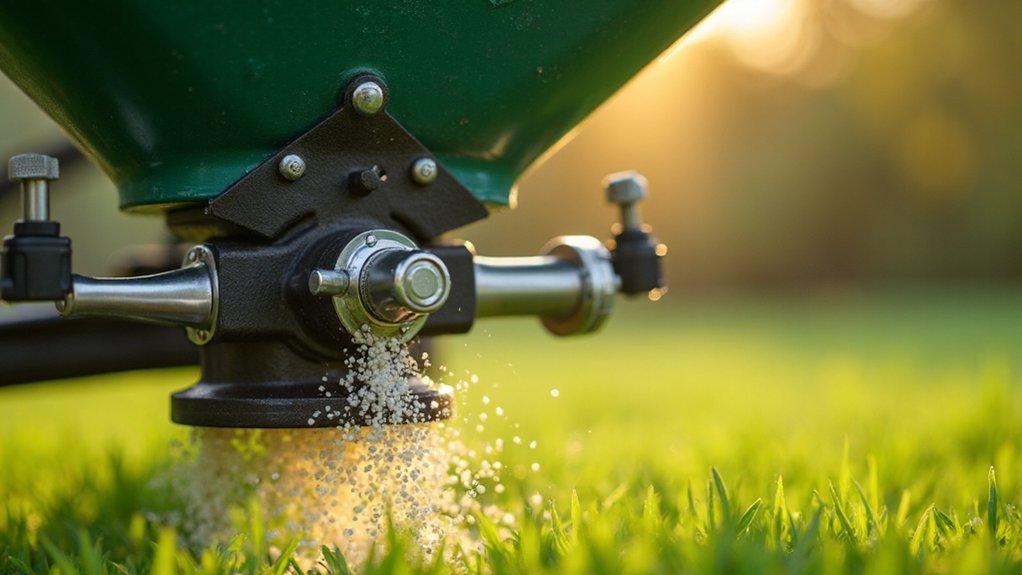
You’ve probably experienced the frustration of patchy grass growth despite your best fertilizing efforts. The culprit isn’t usually the fertilizer itself—it’s uneven application that creates those annoying streaks and bare spots across your lawn. Your spreader’s settings make all the difference between a uniformly green yard and one that looks like it’s been painted with stripes. Once you understand the calibration process, you’ll transform your lawn care routine and achieve professional-looking results.
Key Takeaways
- Calibrate your spreader by walking 20 feet over a tarp, then weigh collected fertilizer to calculate distribution rate.
- Maintain a consistent 3 mph walking speed—time yourself covering 40 feet in 9 seconds for optimal pace.
- Test your spreader’s effective width on pavement to identify where material distribution begins thinning out.
- Apply fertilizer to a small test area first to check for gaps, overlaps, or uneven coverage patterns.
- Make incremental adjustments to flow rate and deflector positions until achieving consistent, even distribution throughout your lawn.
Understanding Application Rates and Coverage Areas
Before you can achieve a lush, healthy lawn, you’ll need to master the fundamentals of fertilizer application rates and coverage calculations. Most fertilizers, including Milorganite, use standardized application rates expressed in 1,000-square-foot increments. You’ll want to apply 12.8 pounds of Milorganite per 1,000 square feet for desirable results.
Start by measuring your lawn area using walking measurements or satellite technology, then break it into manageable 1,000-square-foot segments. This approach helps you calculate the exact weight of material needed for each section. Remember that a 32-pound bag of Milorganite covers 2,500 square feet.
To guarantee accurate distribution, you must calibrate your spreader using a test section. Proper spreader settings combined with consistent walking speed will ensure even coverage across your entire lawn area.
Measuring Your Lawn and Breaking It Into Segments
Once you understand application rates, you’ll need to measure your lawn’s total square footage and divide it into workable segments. Use walking measurements or satellite technology to calculate your lawn’s exact size. This guarantees you’ll get proper coverage the first time without wasting fertilizer.
Break your lawn into 1,000 sq ft segments to determine appropriate fertilizer amounts. For example, a 2,000 sq ft front section requires 25.6 lbs of Milorganite, while a 2,500 sq ft main area needs 32 lbs. This segmented approach prevents under- or over-application.
Make sure you maintain detailed measurements for future reference. Proper lawn maintenance starts with accurate calculations. By dividing your property into manageable sections, you’ll achieve consistent results and avoid costly mistakes that come from guessing coverage areas.
Calibrating Your Spreader for Accurate Distribution
After measuring your lawn segments, you’ll need to calibrate your spreader to ascertain it distributes fertilizer at the correct rate. Start by placing a tarp or collection sheets under your spreader and fill it with fertilizer. Walk twenty feet at your normal walking speed while operating the spreader. Weigh the collected fertilizer and calculate the distribution rate per square foot.
If you’re applying too much fertilizer, reduce the spreader setting. If too little, increase it. Test again until you attain the manufacturer’s recommended rate. Your walking speed directly affects distribution—maintain consistent pace throughout application.
Once calibrated, make adjustments only when switching fertilizer types or brands. This process will validate even coverage across all lawn segments, preventing over-fertilization or bare spots.
Finding the Optimal Walking Speed and Spread Width
The success of your fertilizer application hinges on maintaining the ideal walking speed of 3 mph throughout the entire process. This consistent pace guarantees even coverage across your lawn without creating streaks or missed spots. To verify you’re walking at 3 mph, mark off a 40-foot distance and time yourself – it should take exactly 9 seconds.
Next, determine your spreader’s effective width by testing on a paved platform that’s at least 14 feet wide. Set your dial to 5, walk at 3 mph, and mark where material begins thinning out on each side. This dedicated approach eliminates guesswork from your lawn care routine.
Once you know both your perfect speed and spread width, you’ll have the foundation for accurate calibration and professional-quality results every time.
Testing and Adjusting Settings Based on Results
With your walking speed and spread width established, you’re ready to conduct real-world tests that reveal how your spreader actually performs on grass. Start by applying fertilizer to a small test area, then examine the coverage pattern closely. Look for gaps, overlaps, or uneven distribution that indicate needed adjustments.
When testing and adjusting settings, document what works for different fertilizer types. Dense products like much Milorganite require different settings than lighter synthetic fertilizers. Learn about industry equipment specifications to understand your spreader’s capabilities better.
Make incremental adjustments to flow rate and deflector positions based on test results. Run multiple tests until you achieve consistent, even coverage every time. This methodical approach guarantees optimal fertilizer distribution across your entire lawn.
Rotary Vs Drop Spreader Considerations
Choosing between rotary and drop spreaders fundamentally shapes your fertilizing strategy and results. Rotary spreaders excel at covering large areas quickly, making them ideal for expansive lawns. They’re forgiving with walking speed variations but can struggle with precision near flower beds and sidewalks. Drop spreaders offer superior accuracy and control, perfect for detailed work around landscaping features. However, they require more consistent walking patterns and take longer to cover ground.
Consider your lawn size, layout complexity, and experience level. New Lawn installations benefit from drop spreaders’ precision, while established properties often favor rotary efficiency. Join a community dedicated to lawn care or engage in discussion to learn from other landscaping do it yourselfers about their spreader preferences and real-world experiences with different models.
Common Calibration Challenges and Solutions
Why do even experienced lawn care enthusiasts struggle with spreader calibration? Several factors create persistent headaches that can derail your lawn care efforts.
Moisture affects fertilizer flow dramatically. Humid conditions cause granules to clump, while dry weather makes them scatter unpredictably. Store fertilizer in sealed containers and check flow rates when conditions change.
Worn spreader parts throw off your settings. Replace damaged deflector plates, clean clogged openings, and lubricate moving components regularly. A bent impeller or warped hopper changes distribution patterns immensely.
Walking speed inconsistencies create uneven coverage. Practice maintaining steady 3-mph pace using a stopwatch over measured distances.
Different fertilizer brands require unique settings despite similar N-P-K ratios. Always test new products on cardboard before applying to verify spread patterns match your expectations.
Maintaining Consistent Results Over Time
Successful spreader calibration means nothing if you can’t replicate those results season after season. You’ll need to establish a maintenance routine that keeps your equipment performing consistently.
Clean your spreader thoroughly after each use, removing fertilizer residue that can corrode components and affect flow rates. Check spinner discs, deflectors, and gates for wear or damage before storing. Replace worn parts immediately—even minor deterioration changes application patterns.
Document your successful settings in a logbook, noting fertilizer type, weather conditions, and ground speed. This creates a reference for future applications. Recalibrate annually or when switching fertilizer brands, as different products flow differently.
Store your spreader in a dry location to prevent rust and corrosion. Lubricate moving parts according to manufacturer specifications to guarantee smooth operation and consistent results.
Frequently Asked Questions
How to Evenly Spread Fertilizer on a Lawn?
You’ll achieve consistent product distribution by using proper application technique with overlapping passes. Set your broadcast spreader operation to medium speed, maintaining an efficient spreading pattern through steady walking pace and parallel rows across your lawn.
How to Calibrate a Fertilizer Spreader?
You’ll calibrate by testing your spreader’s wheel speed and adjusting spread pattern settings. Measure actual output against the proper application rate, considering fertilizer particle size. Make adjustments until you’re achieving consistent, even distribution across your lawn.
What Setting Should I Put My Fertilizer Spreader On?
Don’t put the cart before the horse—check your fertilizer’s recommended proper fertilizer rate first. Adjust spreader width adjustment accordingly, plan overlapping spreader passes, and use consistent fertilizer broadcasting technique for uniform coverage.
How to Calibrate a Scotts Spreader?
Start with a low spreader width adjustment like setting 2-3. Apply fertilizer to a 1,000 sq ft test area, weigh what’s dispensed, then adjust spreader speed settings based on fertilizer type considerations and your lawn condition assessment.
Conclusion
You’ve become the conductor of a green symphony, where every spreader setting is an instrument requiring perfect tuning. Like a maestro who’s rehearsed countless hours, you’ll now guide your mechanical orchestra across the lawn’s stage with confidence. Each calibrated pass creates harmonious growth, transforming scattered notes into a unified melody. Your patient practice has earned you the baton – wield it wisely, and your lawn will sing in perfect, emerald harmony season after season.