
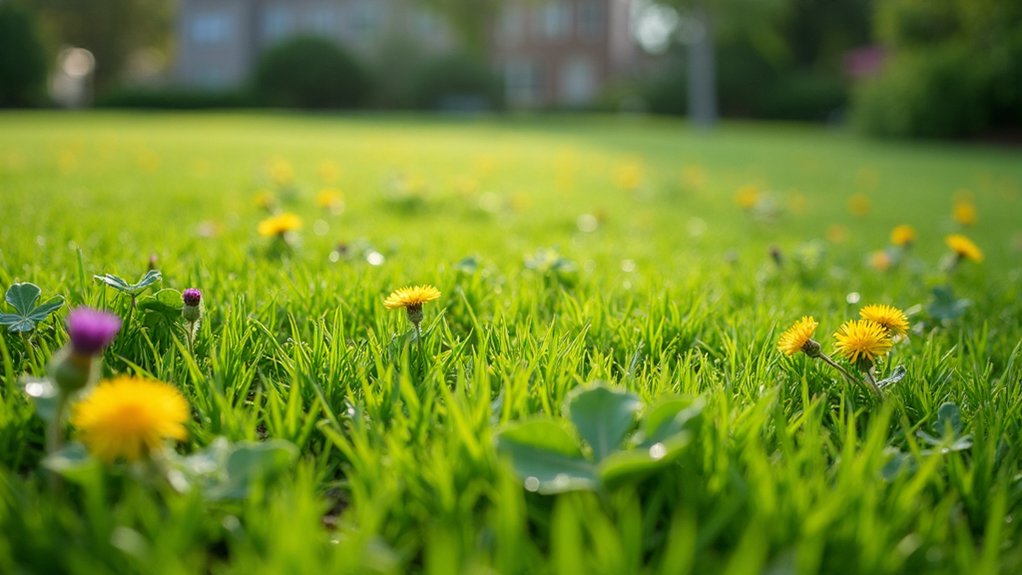
You’ve probably noticed those unwelcome intruders scattered across your otherwise pristine lawn—dandelions, clover, and plantain disrupting your grass’s uniform green carpet. While these broadleaf weeds might seem harmless, they’re actually competing aggressively with your turf for nutrients, water, and sunlight. The key isn’t just eliminating what you can see today, but understanding why they’re thriving in your specific conditions and what that reveals about your lawn’s hidden vulnerabilities.
Key Takeaways
- Identify broadleaf weeds by their wide leaves with netlike veins, contrasting sharply with narrow grass blades.
- Look for distinctive growth patterns like rosettes at the base and showy flowers during blooming seasons.
- Use selective herbicides containing 2,4-D, dicamba, or MCPA that target broadleaves without harming turfgrass.
- Apply atrazine-based treatments for centipedegrass and St. Augustinegrass, or MSM/Celsius for warm-season grasses.
- Hand-pull small weed populations and maintain dense, healthy lawns to prevent future broadleaf establishment.
Understanding Broadleaf Weeds and Their Characteristics
When you’re dealing with lawn weeds, broadleaf varieties are among the most noticeable troublemakers you’ll encounter. These weeds feature wide, distinct leaves with netlike vein patterns that contrast sharply with your grass’s linear blades. You’ll easily spot their showy flowers—think dandelions, clover, and plantain—disrupting your lawn’s uniform appearance.
Understanding each broadleaf weed’s life cycle is essential for effective Broadleaf Weed Control. Some are annuals completing their cycle in one season, while biennials take two years, and perennials return year after year. Proper weed identification determines which broadleaf weed killers or herbicides will work best. Without quick action, these aggressive invaders will outcompete your turfgrass and spread rapidly throughout your lawn.
Common Types of Broadleaf Weeds in Lawns
While broadleaf weeds come in many varieties, five species consistently cause the most problems for homeowners across different regions and grass types. Dandelions are perennial weeds featuring distinctive yellow flowers and deeply lobed leaves that require targeted broadleaf weed killer for effective control. White clover creates creeping mats with trifoliate leaves and white globe-shaped flowers. Plantain develops broad, oval leaves and prominent flower stalks. Ground ivy trails across lawns with round, scalloped leaves and small purple flowers. Common chickweed represents winter annuals, appearing as delicate plants with small oval leaves and white flowers. Understanding each type helps you select appropriate control methods, since annual weeds and perennial weeds respond differently to treatments throughout growing seasons.
Identifying Broadleaf Weeds by Leaf Shape and Growth Patterns
Although broadleaf weeds vary in size and appearance, they share distinctive visual characteristics that make identification straightforward once you know what to look for. You’ll recognize broadleaf weeds by their wide, flat leaves featuring distinct netlike veins, contrasting sharply with grass’s narrow blade-like leaves. Many species display rosette growth patterns at their base, creating circular arrangements of leaves radiating outward from the center.
Pay attention to flowering characteristics during blooming seasons. Dandelions produce bright yellow flowers, while clover displays white or purple blooms. These visual identification cues help distinguish different species. When examining seedlings, you’ll notice broadleaf weeds emerge with two initial leaves, unlike grass seedlings that produce single leaves. Understanding these leaf shape differences and growth habits enables you to identify and target specific broadleaf weeds effectively.
Broadleaf Weed Life Cycles and Timing
Understanding the growth patterns you’ve observed helps you determine when and how these weeds complete their life cycles. Annual broadleaf weeds finish their entire cycle within twelve months. Summer annual varieties germinate in spring, mature during summer, and drop seeds by fall. Winter annual weeds start growing in late summer, survive winter dormancy, then flower the following spring.
Biennial broadleaf weeds require two full years to complete their cycle, producing seeds only in their second year. Perennial broadleaf weeds present the greatest challenge since they survive multiple years and spread through both seeds and underground root systems.
Timing your control methods properly is essential for success. Target perennial varieties in early fall when they’re storing energy in their roots, making herbicide treatments most effective.
Inspection Techniques for Problem Areas
Before you can effectively control broadleaf weeds, you need to systematically inspect your lawn to identify problem areas and determine which species you’re dealing with. Walk your entire property during early morning or late afternoon when lighting enhances weed visibility.
Focus on areas with thin turf, as these spots typically harbor the highest weed populations. Check the density of the lawn in each section, noting where grass coverage drops below 80%. Different types of broadleaf weeds prefer specific conditions, so examine sunny slopes, shaded areas, and moist spots separately.
Identify each weed type by examining leaf shape, growth patterns, and flowers. Common species like buckhorn plantain grow upright, while mouse-ear chickweed exhibits a prostrate growth habit. Document broadleaf weed species locations for targeted treatment planning.
Selective Herbicide Treatment Options
Once you’ve mapped out your weed problem areas and identified the species present, selective herbicides offer your most effective control method. Products containing 2,4-D, dicamba, MCPA, MCPP, and triclopyr will control many broadleaf weeds without damaging your turfgrass species. For centipedegrass and St. Augustinegrass, atrazine-based formulations provide excellent selective control. MSM Turf Herbicide and Celsius WG offer broad-spectrum options for warm-season grasses, targeting both broadleaf and grassy weeds effectively.
Always read the product label carefully before herbicide applications to guarantee compatibility with your specific lawn type. Proper timing and application rates are essential for Weed Control in Turfgrass success. Maintain a dense, Healthy lawn through regular fertilization and overseeding, as thick turf naturally crowds out weeds and reduces future infestations.
Mechanical Removal Methods
While chemical treatments offer efficient broad-spectrum control, mechanical removal provides a targeted, chemical-free approach that’s particularly effective for small weed populations. Hand-pulling dandelions and clover works best when you target moist soil conditions, making root extraction easier. You’ll want to dig deep enough to remove the entire root system, preventing regrowth.
Using garden tools like hoes and cultivators helps you uproot stubborn weeds more efficiently than pulling by hand alone. Repeated removal over growing seasons leads to resource exhaustion, weakening the weed’s ability to re-establish. This persistence is vital to long-term success.
Proper weed disposal is essential—don’t compost pulled weeds or leave them on your lawn where they might spread seeds or re-root.
Maintaining Dense Lawn Health for Prevention
A thick, vigorous lawn serves as your best defense against broadleaf weed invasion, creating conditions where desirable grass outcompetes unwanted plants for space, nutrients, and sunlight. Your dense lawn depends on proper lawn care fundamentals: regular mowing at appropriate heights, consistent watering schedules, and balanced fertilization programs that strengthen lawn grasses.
You’ll need to address underlying issues that thin your turf canopy. Avoid low mowing, which weakens grass and creates openings for weeds. Correct poor soil conditions and compaction that stress your lawn. Your management practices should include controlling diseases that reduce grass density and addressing environmental factors like drainage problems or excessive shade that favor weed establishment.
Seasonal Control Strategies for Maximum Effectiveness
Since broadleaf weeds follow predictable growth cycles throughout the year, you’ll achieve better control results by timing your treatments to match their periods of greatest vulnerability. Target dandelions, clover, and plantain in fall when they’re most susceptible to herbicide applications. Apply pre-emergent treatments in late spring or early summer before your lawn begins its peak growing season to prevent annual weeds like chickweed and henbit from germinating.
During spring or early summer’s active growing season, use selective herbicides containing 2,4-D, dicamba, or triclopyr against each type of broadleaf weed. Spot-treat newly emerged weeds in summer around ornamental plants and landscape beds. Kill broadleaf weeds effectively by always following label directions for proper application timing and rates.
Frequently Asked Questions
What Is the Best Spot Treatment for Broadleaf Weeds?
You’ll get best results using selective broadleaf weed killers with targeted herbicide application during fall. Combine weed identification techniques with proper spot treatment application timing, plus integrate non-chemical control methods for exhaustive integrated weed management strategies.
How Do You Identify Broadleaf Weeds?
You’ll identify broadleaf weeds by examining their flat, wide leaf shape versus narrow grass blades. Check stem characteristics, flower type, and growth habit. Common species include dandelions and clover, thriving in various environmental factors requiring targeted management practices.
What Is the Best Way to Treat Broadleaf Weeds?
Strategically select selective herbicide application for post emergent treatment timing. You’ll prevent weed competition through cultural control methods, integrated pest management, and non chemical removal techniques while considering environmental factors and pre emergent herbicide use.
How Do You Control Broad Leaved Weeds?
You’ll control broad-leaved weeds through integrated pest management combining selective herbicide application, organic weed management, and mulching techniques. Focus on perennial weed eradication while promoting native grass growth and soil health improvement for effective weed prevention strategies.
Conclusion
You’ll find it’s no coincidence that the healthiest lawns suffer fewer broadleaf invasions—just as you’re building your weed identification skills, you’re simultaneously creating conditions that naturally discourage their growth. Your timing with herbicide applications will coincidentally align with when weeds are most vulnerable, while your consistent mowing and fertilizing routines happen to strengthen grass density. These overlapping efforts aren’t accidental; they’re creating a system where prevention and treatment work together seamlessly.