
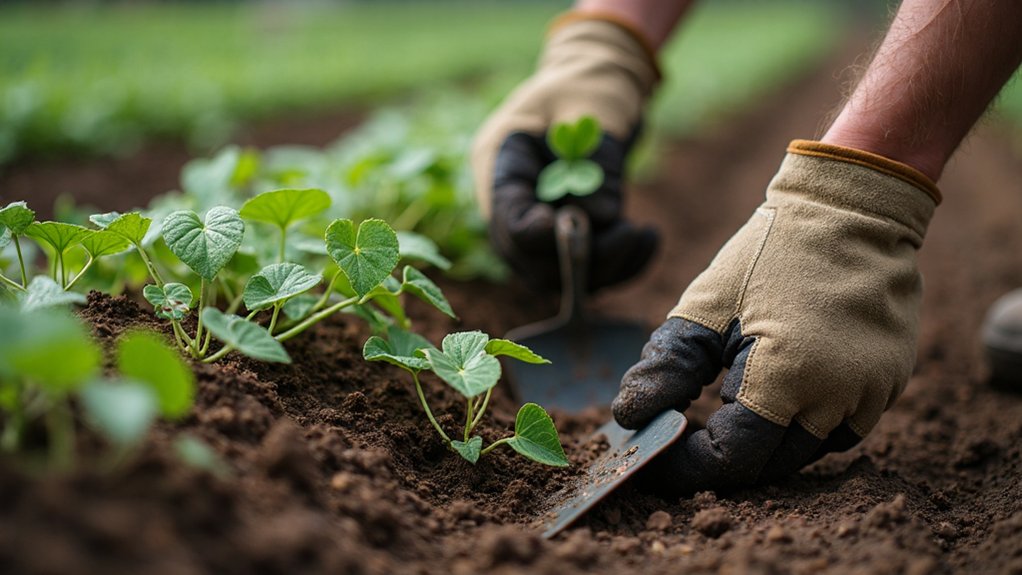
You’ve likely encountered bindweed’s stubborn vines choking your garden plants, and you know that pulling a few stems won’t solve the problem. This persistent weed’s extensive underground root system can stretch fifteen feet in all directions, making it one of agriculture’s most challenging adversaries. What you might not realize is that effective bindweed control requires a strategic, multi-year commitment that goes far beyond the typical weekend gardening approach most homeowners attempt.
Key Takeaways
- Combine repeated physical removal every 2-3 weeks with deep cultivation for 3-5 years to exhaust root reserves.
- Apply glyphosate herbicides during flowering stage when chemical translocation to roots is maximized for systemic control.
- Plant competitive crops like sorghum and sudangrass in dense stands to create shade and suppress bindweed growth.
- Implement strict prevention measures including seed inspection, equipment cleaning, and immediate control of new infestations.
- Use integrated approach combining herbicides, physical removal, and competitive cropping across multiple growing seasons for elimination.
Understanding Bindweed Characteristics and Growth Patterns
When you’re dealing with bindweed infestations, understanding this persistent weed’s aggressive nature is essential for successful elimination. This perennial spreads through an extensive root system that can survive in soil for years, making control particularly challenging. You’ll recognize bindweed by its arrow-shaped leaves and milky sap that appears when stems break. The climbing growth pattern allows it to smother other plants while establishing dominance in your garden.
Bindweed’s persistence stems from rapid root development—seedlings form deep taproots and lateral roots within six weeks of emergence during the growing season. Each seed produces a formidable opponent that requires immediate attention. The waxy leaf surfaces create barriers to herbicide absorption, limiting translocation effectiveness. Understanding these characteristics helps you develop targeted strategies against these troublesome weeds.
Physical Removal Methods and Timing Requirements
Although physical removal requires significant commitment, it remains one of the most effective long-term strategies for bindweed control. You’ll need to commit to repetitive digging and pulling every 2-3 weeks throughout the growing season for 3-5 years minimum. Use the deepest cultivation implements available, particularly a garden fork, to extract roots thoroughly. Any remaining root portions will re-sprout within two weeks, making consistent manual removal indispensable.
High clay soils actually work to your advantage, allowing deeper root extraction during routine digging sessions. Between removal efforts, let bindweed grow and flower briefly—this helps deplete the plant’s carbohydrate reserves over time. Your persistent efforts will gradually weaken the extensive root system until you’ve completely eliminated this stubborn weed.
Herbicide Applications for Systemic Control
Several systemic herbicides can effectively penetrate bindweed’s waxy surfaces and target the plant’s extensive underground network where physical removal falls short. Glyphosate herbicides like Roundup provide the most reliable long-term control when you apply them during the flowering stage. This timing guarantees maximum translocation of the chemical throughout the root system. You’ll likely need multiple applications over several growing seasons to fully eliminate dense infestations.
- Timing matters: Apply glyphosate when bindweed flowers for ideal system penetration
- Multiple treatments: Plan for 2-3 years of consistent application to exhaust root reserves
- Combination approach: Mix herbicides like 2,4-D, dicamba, or picloram with glyphosate for enhanced control
- Enhanced cultivation: Use garden forks after chemical treatment to expose weakened root systems
Prevention Strategies to Stop New Infestations
While herbicide treatments target existing bindweed populations, preventing new infestations requires vigilant monitoring of potential contamination sources that can introduce seeds to clean areas. You’ll need to inspect crop seeds thoroughly before planting to remove any bindweed seeds that could contaminate your fields. Clean all machinery moving between infested land and uninfested areas, as equipment can transport seeds on wheels and attachments. Restrict livestock that’ve consumed contaminated grain or hay, since they can spread viable seeds through droppings. Apply contaminated manure only on already infested land rather than clean fields. Control new infestations immediately in both crop and non-crop areas to prevent further spread. These prevention strategies form your first line of defense against bindweed expansion across your property.
Competitive Cropping and Natural Suppression Techniques
Beyond chemical and preventive measures, you can harness the power of competitive crops to naturally suppress bindweed populations through strategic planting decisions. Dense, vigorous plants effectively outcompete weeds for sunlight and nutrients, weakening bindweed’s entire root system throughout your field.
- Plant tall, dense forage crops – Sorghum and sudangrass create shade canopies that suppress bindweed growth much better than sparse plantings
- Use narrow-row grain sorghum – Closer spacing maximizes competition for light and resources, preventing bindweed establishment
- Maintain continuous wheat stands – Healthy winter wheat considerably reduces infestations in rotation systems
- Combine competitive crops with herbicide – Strategic timing helps kill existing weeds while establishing vigorous crops to manage field bindweed long-term
Healthy, competitive crops naturally reduce bindweed’s ability to grow and spread.
Tillage Practices for Root System Depletion
How can you systematically weaken bindweed’s extensive underground network when competitive cropping alone isn’t enough? You’ll need aggressive tillage targeting the deep and extensive root system that makes this weed so persistent. Mowing isn’t effective since bindweed’s energy reserves lie underground, not in surface shoots.
Implement shallow tillage every 12-16 days throughout the growing season to deplete the root system’s carbohydrate stores. Use sweep-type implements that cut bindweed shoots 4 inches below soil surface—this approach effectively weakens the small feeder roots while disrupting the main taproot network.
Time your tillage to prevent bindweed seed production, which would create future problems for your crops. Remember that poor timing can reduce herbicide effectiveness, so coordinate mechanical and chemical treatments. This systematic approach will kill roots through repeated stress and resource depletion.
Combining Multiple Control Methods for Maximum Effectiveness
Since bindweed’s persistence stems from its complex biology and adaptive strategies, you’ll achieve the ideal results by layering multiple control tactics rather than relying on any single approach. Successful control requires integrating physical, chemical, and biological methods systematically. You’ll need persistence and dedication, as this process spans several growing seasons.
Start with digging and pulling every shoot you see, repeating every two to three weeks to exhaust the root system. Follow up with chemical control using systemic herbicides during flowering, then re-treat the affected area when regrowth appears. Take care to avoid herbicide drift to desirable plants. Finally, establish competitive crop planting with dense, fast-growing species like sorghum to shade out remaining bindweed. This integrated approach provides long-term suppression of persistent infestations.
Key Integration Strategies:
- Combine tillage with herbicide applications for maximum root system depletion
- Time chemical treatments during peak flowering for perfect translocation
- Plant competitive crops immediately after control treatments
- Monitor and retreat problem areas consistently over multiple seasons
Frequently Asked Questions
How to Permanently Get Rid of Bindweed?
You’ll permanently eliminate bindweed through persistent hand pulling methods, organic mulch application, solarization soil temperature increase, and landscape fabric barriers. Combine repeated mowing schedules with crop rotation planning to exhaust nutrient reserves and achieve deep root competition effectively.
What Chokes Out Bindweed?
Ironically, bindweed thrives on neglect, yet you’ll choke it out through relentless competition planting with deep rooted perennials, dense cover cropping methods, strategic mulch application, and native groundcovers that aggressively compete for resources.
What Is the Best Herbicide for Bindweed Control?
For effective bindweed control, you’ll find glyphosate-based herbicides work best during flowering, requiring multiple selective herbicide applications. Picloram mixtures provide superior rhizome eradication techniques, while integrated pest management strategies combining herbicides with competitive crops guarantee long-term success.
Is It Better to Pull or Cut Bindweed?
You should pull bindweed rather than cut it. Manual removal strategies targeting the root system prove more effective than cutting. Understanding bindweed growth patterns helps with organic control options requiring repeated pulling every 2-3 weeks.
Conclusion
You’ve got the blueprint to wage war against bindweed’s iron grip on your garden. Don’t expect overnight victories—this weed’s like a hydra, requiring years of persistent battle. Your success hinges on wielding multiple weapons: relentless digging, strategic herbicide strikes, and choking it out with competitive crops. Stay consistent with your assault plan, and you’ll eventually starve this green monster’s sprawling underground empire into submission.