
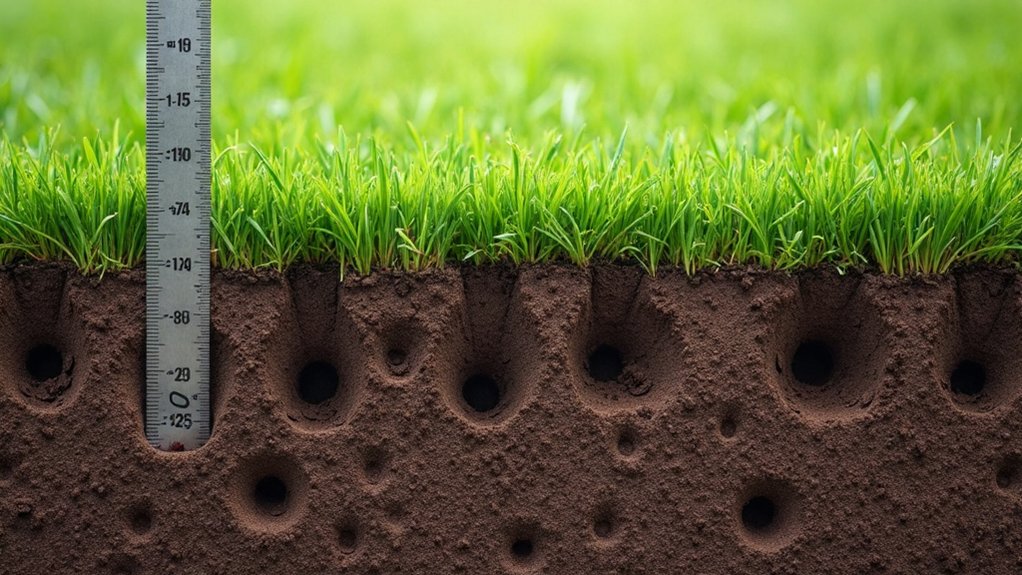
You’re probably giving your lawn a “gentle soil massage” when what it really needs is strategic penetration that reaches the root zone. Most homeowners guess at aeration depth, but there’s actually a science behind how deep those cores should go. The wrong depth won’t just waste your time—it can actively work against your lawn’s health and leave you wondering why your grass isn’t responding. Here’s what determines the perfect depth for your specific situation.
Key Takeaways
- Core aeration depth typically ranges from 2-4 inches, with actual penetration depending on soil conditions and equipment capabilities.
- Sandy soils require deeper 3-4 inch aeration, while clay soils benefit from shallower 2-3 inch penetration for optimal results.
- Shallow 1-2 inch aeration works best for overseeding projects to maintain proper seed-to-soil contact and germination rates.
- Signs requiring deeper 3-4 inch aeration include thick thatch buildup, poor drainage, heavy soil compaction, and high-traffic areas.
- Standard aerators reach 2-4 inches deep, while professional equipment can penetrate up to 6 inches when extreme depth is needed.
What Is Core Aeration and Why Depth Matters
While many homeowners understand the basics of lawn care, core aeration remains one of the most misunderstood yet critical practices for maintaining healthy grass. Core aeration involves mechanically removing small plugs of soil from your lawn, creating channels that allow air, water, and nutrients to reach grass roots more effectively.
The depth of these holes directly impacts your results. When aeration penetrates 2-4 inches deep, it effectively tackles compacted soil layers that restrict root growth and water infiltration. However, if you’re planning to overseed, holes that are 1-2 inches deep work better since seeds won’t fall too far below the surface.
Your soil type and existing lawn conditions determine the ideal depth for maximum benefits.
Standard Aeration Depths for Different Lawn Conditions
Since your lawn’s compaction level determines the most effective aeration depth, you’ll need to assess your soil conditions before choosing the right approach. For lawns with mild soil compaction, core aeration at 2-3 inches provides adequate relief without excessive disruption. If you’re dealing with heavily compacted areas, you’ll want to increase your aeration depth to 3-4 inches to effectively break up dense soil layers.
When overseeding, shallow aeration of 1-2 inches works best because it creates ideal seed-to-soil contact without burying seeds too deeply. However, severely compacted or clay-heavy lawn conditions require deeper penetration of 4-6 inches to reach problem areas. Remember that matching your aeration depth to your specific lawn conditions guarantees maximum effectiveness and healthier grass growth throughout the growing season.
Soil Type Impact on Optimal Penetration Depth
Although compaction levels matter greatly, your soil’s composition plays an equally critical role in determining the perfect aeration depth. Sandy soils demand deeper penetration of 3-4 inches because their loose structure requires more aggressive treatment to extract meaningful soil cores from compact soil layers below. Clay-based soils respond well to shallower 2-3 inch depths since their dense composition benefits from surface-level relief. Your loamy soil composition strikes the perfect middle ground, typically requiring 2.5-3.5 inches for ideal results.
Each soil type responds differently to core removal. Sandy soils need deeper access to reach truly compacted zones, while clay soils improve dramatically with moderate penetration. Professional soil testing reveals your specific soil composition, eliminating guesswork and ensuring you’re aerating at the most effective depth for lasting results.
Balancing Aeration Depth With Overseeding Requirements
The relationship between aeration depth and overseeding success requires careful consideration of competing priorities. When you’re planning to overseed, you’ll need to balance soil decompaction benefits with ideal seed germination conditions. Core aeration plugs of 1-2 inches work best for overseeding since they create perfect seed-to-soil contact without burying seeds too deeply. However, if you’re dealing with severely compacted soil, deeper 4+ inches penetration provides better long-term soil health but may hinder seed establishment.
Aerating with multiple shallow holes often outperforms fewer deep ones for overseeding projects. This approach maximizes surface area for seed contact while still improving soil conditions. Consider your lawn’s specific needs, soil type, and the growing season when determining your strategy. You’ll achieve better results by matching aeration depth to your primary goal.
Equipment Limitations and Depth Capabilities
Equipment selection directly impacts your aeration depth capabilities, with most standard aerators reaching maximum plug depths between 2-4 inches. When you’re aerating, the actual plug depth you’ll achieve depends heavily on your machine’s specifications and current soil conditions. Compact, hard soils will challenge even professional-grade equipment, potentially reducing your core aeration penetration by several inches.
High-end aerators can reach up to 6 inches deep, but you’ll rarely need this extreme depth for typical lawn care. Your equipment’s weight, tine design, and power source all influence how effectively it penetrates compacted ground. Walk-behind units typically offer less penetration than ride-on models, while rental equipment may have worn tines that reduce maximum depth capabilities extensively.
Signs Your Lawn Needs Deeper Core Penetration
Several unmistakable indicators reveal when your lawn requires deeper core penetration beyond the standard 2-3 inch depth. Heavy thatch buildup exceeding half an inch creates a barrier that demands 3-4 inch penetration to break through effectively. You’ll need deep core aeration in heavily trafficked zones like driveways, walkways, and pet areas where compacted soil prevents proper root development. Clay-based and silt-rich soils that absorb water slowly benefit from deeper penetration to alleviate density issues. Poor drainage manifests as standing water or boggy conditions, signaling the need for 3-4 inch core depth to improve infiltration. If you haven’t aerated in several years, significant soil compaction has likely developed, requiring deeper penetration to revitalize your lawn’s foundation.
Shallow Vs Deep Aeration: Comparing Results
Understanding when your lawn needs deeper penetration leads naturally to comparing how different aeration depths perform in practice. When you’re core aerating for overseeding, shallow penetration (1-2 inches) creates more holes per square foot, giving your Kentucky bluegrass seeds better soil contact. However, deeper aeration (4+ inches) more effectively reduces soil compaction from heavy foot traffic and allows superior water and nutrient penetration to existing roots.
You’ll find shallow aeration works well for newer lawns needing minor improvements, while deeper penetration tackles severely compacted soils with hardpan layers. The trade-off is clear: shallow holes support seed germination but provide limited compaction relief, whereas deep holes dramatically improve soil conditions but create gaps too large for ideal seed establishment in your lawn.
Seasonal Considerations for Aeration Depth
When seasons change, your aeration depth strategy should adapt to match your grass type’s natural growth cycles. Cool season grasses need deeper penetration during fall aeration when they’re actively growing, while warm season varieties require different timing and depth considerations during their peak growth period.
Your soil moisture management directly impacts how deep you should aerate. Water your lawn 1-3 days before aerating to achieve ideal soil conditions for effective penetration.
- Cool season grasses: Aerate 2-4 inches deep during fall for maximum recovery
- Warm season grasses: Apply deeper aeration (3-4 inches) during late spring through summer
- Severely compacted soil: Requires deeper aeration depth regardless of season
- Overseeding projects: Use shallow 1-2 inch depth for better seed contact
- Soil moisture: Maintain moist but not saturated conditions before aerating
Common Depth Mistakes That Hurt Your Lawn
Even experienced homeowners frequently make critical depth errors that can set back their lawn’s health for months. The most damaging mistake is aerating too shallow at just 1/4 inch depth. This superficial approach won’t penetrate compacted soil layers, making it a waste of time to aerate without achieving meaningful results.
Conversely, going beyond 3 inches creates severe root damage that stunts grass growth. You’ll destroy the very foundation you’re trying to strengthen. Aerating your lawn at extreme depths also makes overseeding nearly impossible, as new seedlings can’t bridge the gap to establish properly.
The best approach maintains ideal core aeration depth between 2-3 inches. This range effectively breaks up compaction while preserving root integrity, ensuring your investment pays off with healthier, more resilient turf.
Professional Recommendations for Maximum Effectiveness
Professional lawn care specialists consistently recommend core aeration depths between 2-4 inches to maximize soil health benefits. You’ll achieve optimal results by matching depth to your lawn’s specific conditions and soil type.
For maximum effectiveness, follow these professional guidelines:
- Compacted soil: Use 3-4 inch depths to break through dense layers and restore proper drainage
- Clay soils: Penetrate deeper (3-4 inches) due to harder composition requiring more aggressive treatment
- Overseeding projects: Stay within 2-3 inches to maintain ideal seed-to-soil contact without burying seeds too deep
- Sandy soils: Use standard 2-3 inch depths since these soils compact less severely
- High-traffic areas: Apply maximum 4-inch depth to address heavy compaction from foot traffic
Consistent annual core aeration at proper depths guarantees your lawn health improves progressively each season.
Frequently Asked Questions
How Deep Should Core Aeration Go?
You’ll achieve ideal aeration depth at 2-4 inches for most lawns. Consider your soil compaction levels when deciding – harder soils need deeper penetration. Core size importance and lawn health benefits depend on matching depth to your specific conditions.
How Deep Should Core Aeration Go on Reddit?
You’ll find Reddit users recommend 2-3 inch depths for proper aeration technique. They discuss various aeration equipment options, timing considerations for different grasses, and emphasize that best times for aeration depend on your specific soil conditions.
Can You Spike Aerate Too Much?
Yes, you can spike aerate too much. Excessive aeration worsens thatch build up issues, doesn’t address soil compaction levels properly, disrupts your aeration schedule timing, and requires careful aerator machine settings to avoid damaging grass roots.
Is October Too Late to Aerate a Lawn?
October’s ideal for aeration! You’ll achieve perfect fall timing for soil compaction impact relief. Your lawn gains thatch removal benefits and meets soil amendment needs before winter dormancy. Don’t delay—early October maximizes recovery time for healthier spring growth.
Conclusion
Getting your aeration depth right isn’t rocket science—it’s the difference between a lawn that thrives and one that barely survives. You’ve got the roadmap now: match depth to your soil, balance it with your goals, and don’t let equipment limitations derail your success. Your lawn’s crying out for relief from compaction, and with proper depth, you’ll uncover its hidden potential. Stop guessing and start aerating with purpose.