
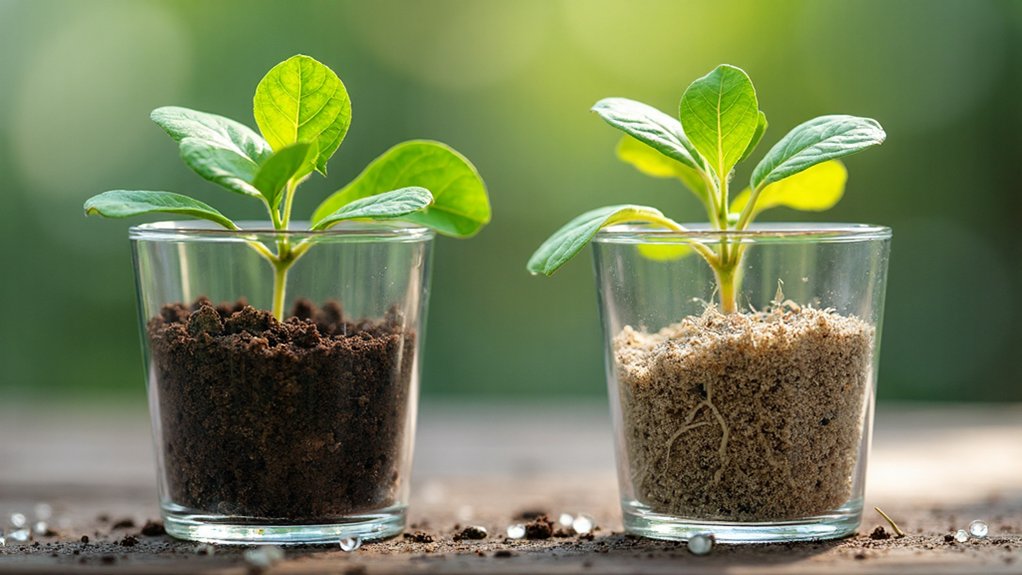
Like Goldilocks searching for the perfect porridge, you’re seeking that “just right” soil pH for your plants—but getting it wrong can spell disaster for your garden. When your soil becomes too acidic or alkaline, it doesn’t just affect plant growth; it completely transforms which nutrients your plants can actually absorb from the ground. You might be fertilizing regularly and still watching your crops struggle, never realizing that pH imbalance is hijacking your efforts and wasting your investment.
Key Takeaways
- Soil pH directly controls nutrient availability, with most essential nutrients becoming inaccessible below pH 6.0 or above pH 8.0.
- Acidic soils below pH 5.0 create aluminum and manganese toxicity that severely damages plant roots and impairs nutrient uptake.
- Phosphorus availability peaks between pH 6.0-7.0, then sharply declines in alkaline conditions, limiting plant growth and development.
- Iron, manganese, and zinc become increasingly unavailable as soil pH rises above neutral, causing nutrient deficiency symptoms.
- The optimal pH range of 6.0-7.0 maximizes nutrient absorption efficiency and prevents both acidity toxicity and alkaline nutrient lockup.
Understanding Soil Ph Scale and Its Impact on Plant Growth
When you examine your garden soil, you’re looking at a complex chemical environment where pH acts as the master key controlling nutrient availability for your plants. The soil pH scale measures soil acidity from 0-14, with 7.0 being neutral. Values below 7.0 indicate acidic conditions, while above 7.0 signals alkaline soil.
Your soil’s pH directly impacts plant growth by determining which nutrients your plants can actually absorb. When soil acidity drops too low, aluminum and manganese become toxic to roots. Conversely, high pH levels lock away essential phosphorus and micronutrents. The sweet spot for most plants lies between 6.0-7.5, where nitrogen, phosphorus, potassium, and other crucial nutrients remain accessible within the soil solution. You can adjust pH using liming materials to raise it or sulfur-based amendments to lower it.
How Acidic Soils Form and Develop Over Time
Understanding why your soil becomes acidic helps you make better long-term management decisions for your garden or farm. Soil acidification occurs naturally in high-rainfall areas where water leaches away essential nutrients like calcium and magnesium. However, your farming practices can accelerate this process considerably.
When you apply ammonium-based fertilizers repeatedly, you’re adding compounds that release hydrogen ions, lowering your soil pH. Similarly, removing crop residues prevents natural buffering that plant materials provide. Even beneficial practices like building organic matter can contribute to acidification as decomposing materials release acids.
The leaching process intensifies in areas with heavy precipitation, washing away basic cations faster than they’re replenished. You’ll need to monitor your soil pH regularly and adjust your fertilization strategy accordingly to maintain ideal growing conditions.
The Role of Aluminum and Manganese Toxicity in Low Ph Soils
As your soil’s pH drops below 5.0, aluminum and manganese transform from harmless soil components into dangerous plant toxins. Low pH conditions dramatically increase the solubility of these metals, making them readily available for plant uptake. Aluminum toxicity poses the greatest threat, severely limiting or completely halting root development. This disruption prevents proper nutrient and water absorption, resulting in stunted growth, yellowing leaves, and reduced crop yields.
Manganese toxicity manifests differently, creating brown speckles and dead spots on leaves while impairing photosynthesis and root function. Both toxicities compromise your plants’ ability to thrive. Liming becomes essential to raise soil pH and reduce metal solubility. By neutralizing acidity, you’ll minimize aluminum and manganese toxicity while restoring proper nutrient availability for healthy plant growth.
Nutrient Availability Changes Across Different Ph Levels
While aluminum and manganese toxicity create serious problems in acidic soils, pH changes affect the availability of all essential nutrients in your garden. Different pH values dramatically alter how plants access nutrients from soil. Most essential plant nutrients become less available as pH drops below 6.0 or rises above 8.0.
Phosphorus availability peaks between pH 6.0-7.0, then sharply declines in alkaline conditions. Iron, manganese, and zinc become increasingly unavailable as pH rises, while calcium and magnesium availability increases. The pH range for optimum nutrient uptake spans 6.0-7.0 for most crops.
Understanding how pH affects the availability of each nutrient helps you make informed fertilization decisions. You’ll achieve better results by adjusting soil pH before adding fertilizers, ensuring your plants can actually absorb the nutrients you’re providing.
Limestone and Liming Materials for Soil Ph Correction
When your soil test reveals acidic conditions that limit nutrient availability, limestone becomes your primary tool for pH correction. Calcium carbonate limestone (CaCO3) and dolomitic limestone offer the most economical solutions for raising soil pH. The effectiveness of these liming materials depends on their purity and particle size—finer ground limestone reacts faster for quicker pH adjustment.
If you need rapid soil acidity correction, hydrated lime (Ca(OH)2) provides immediate results but costs more than traditional limestone. Alternative options include marls and basic slag, both offering 70-90% neutralizing value. Modern fluid lime and pelletized limestone deliver more uniform application and faster pH response than conventional ground limestone, making them excellent choices when you’re targeting precise soil pH modifications across larger areas.
Calculating Effective Calcium Carbonate Content and Application Rates
Two key factors determine how effectively your limestone will neutralize soil acidity: the calcium carbonate equivalent (CCE) and particle size fineness. You’ll calculate the effective calcium carbonate content (ENV) by multiplying total fineness efficiency by the percentage of calcium carbonate equivalent divided by 100. Choose a lime product with at least 90% neutralizing value for ideal soil pH adjustment.
Your application rates depend on three critical factors: your target soil pH, your soil’s buffer capacity, and the ENV of your selected lime product. Finely ground limestone passing through 200-mesh screens reacts quickly to change soil pH, while pelletized lime requires rainfall or irrigation time before soil incorporation. Calculate your specific needs based on these measurements for precise pH correction.
Timing and Placement Strategies for Maximum Lime Efficiency
Although calculating the right lime application rate sets the foundation for pH correction, your timing and placement decisions ultimately determine whether that lime will effectively neutralize soil acidity.
For legumes, you’ll need to apply lime 3-6 months before planting to guarantee proper soil pH adjustment. Your soil sample results should guide whether you use deep plowing for subsoil distribution or shallow mixing for the plow layer.
Consider these timing and placement strategies:
- No-till systems: Surface applications can influence soil pH below 2 inches after four years
- Emergency corrections: Fluid lime changes soil pH quickly after crop planting
- Pelletized lime: Allow rainfall to dissolve pellets before mixing soil to maximize affected volume
- Deep placement: Use when plant growth requires subsoil acidity correction
Managing Alkaline Soils and Excess Calcium Carbonate
While acidic soils present their own challenges, you’ll face an entirely different set of problems when managing alkaline soil with excess calcium carbonate. High soil pH creates micronutrient deficiencies that’ll severely impact your crops’ nutrient availability. You’re particularly at risk in semi-arid regions where natural conditions promote calcium carbonate buildup, and irrigation water can add 300-600 pounds of carbonates per acre-foot.
To combat these conditions, you’ll need soil acidifiers like elemental sulfur, which converts to sulfuric acid more rapidly when finely ground. Aluminum sulfate offers another option, though you’ll require 2-7 times higher application rates compared to elemental sulfur for equivalent soil pH reduction. Proper acidification restores ideal nutrient uptake and prevents costly deficiency symptoms.
Using Sulfur and Aluminum Sulfate for Soil Acidification
When you’re selecting acidifying agents for your alkaline soil, elemental sulfur stands out as the most cost-effective option. It converts to sulfuric acid over time, gradually lowering your soil pH through hydrogen ion release. While aluminum sulfate works faster, you’ll need 2-7 times more to achieve the same soil acidification results.
Here are key considerations for effective application:
- Choose finely ground elemental sulfur for faster conversion rates due to increased surface area
- Monitor your soil pH regularly to prevent over-acidification and potential toxicity
- Apply smaller, repeated doses rather than large single applications
- Remember that acidifying effects are more localized and temporary compared to lime applications
Both agents require careful rate calculations since excess application can damage your plants and create overly acidic soils.
Variable Charge Effects on Nutrient Sorption and Plant Uptake
Beyond simply adjusting soil pH with acidifying agents, you must understand how variable charge minerals in your soil create complex interactions that directly impact nutrient availability. When you raise soil pH, negatively charged surfaces become more deprotonated, which enhances anion sorption for nutrients like phosphate and molybdate while decreasing cation sorption for zinc and copper. This creates a delicate balance between increased sorption and reduced plant uptake that varies by nutrient type. You’ll find that highly weathered tropical soils with abundant variable charge minerals show greater sensitivity to pH changes than temperate soils with permanent charge clays. Remember that measuring soil pH alone won’t capture these complex nutrient reactions—you need to examine your soil’s variable charge properties too.
Frequently Asked Questions
How Does Soil Ph Affect Nutrient Absorption?
Your soil’s pH directly influences nutrient cycling and microbial activity, affecting cation exchange capacity. When pH isn’t ideal, you’ll see reduced plant growth because nutrients become unavailable, regardless of organic matter or water retention levels.
How Does Acidity Affect Soil Availability of Nutrients?
When acidity strikes your soil, it’s [releasing/freeing/triggering] chaos—nutrient leaching accelerates, microbial activity plummets, cation exchange capacity drops dramatically. Your soil structure deteriorates while organic matter decomposition slows, ultimately strangling plant growth through severe nutrient deficiencies.
How Does Soil Ph Influence the Availability of Five Nutrients?
You’ll find soil pH directly impacts nitrogen fixation, microbial activity, and cation exchange capacity. It affects micronutrient availability, organic matter decomposition rates, and plant root development, ultimately controlling how five key nutrients become accessible to your plants.
How Is Ph Involved With Soil Fertility?
Like a master key, pH opens soil’s potential by regulating soil microbial activity, soil nutrient cycling, and soil cation exchange capacity. You’ll find it controls soil physical structure, soil water holding capacity, and soil organic matter content.
Conclusion
You’ll be amazed to learn that adjusting your soil’s pH by just one unit can increase nutrient availability by up to 500%. That’s the power of proper pH management in your garden or farm. By testing your soil regularly and applying the right amendments—whether it’s limestone for acidic conditions or sulfur for alkaline soils—you’re setting yourself up for dramatically improved plant health and yields. Don’t underestimate this simple yet transformative soil management practice.