
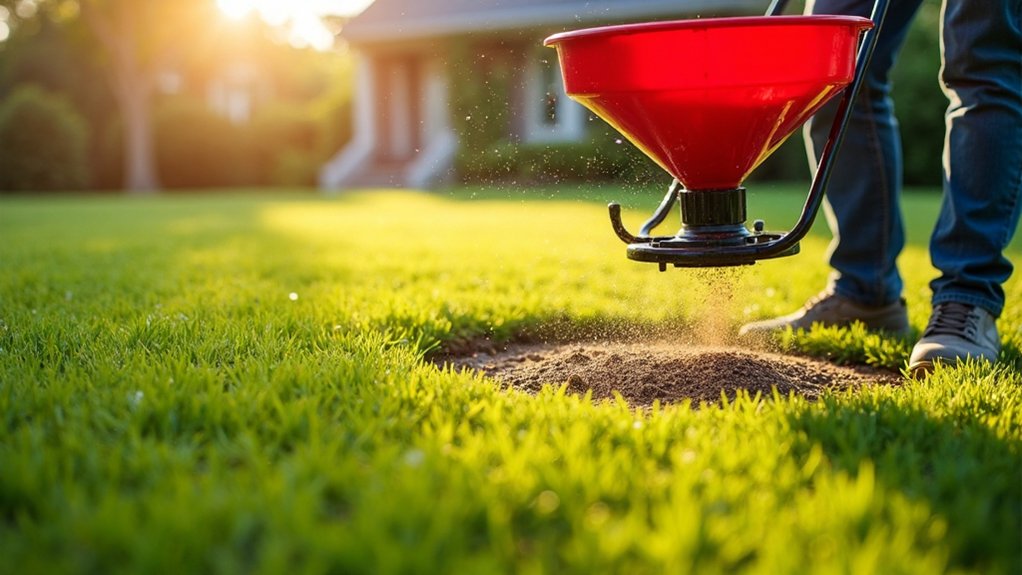
You’re spending nearly $3,000 annually on professional lawn care services that you could handle yourself for a fraction of the cost. Most homeowners don’t realize that fertilizing their own lawn isn’t just about saving money—it’s about gaining complete control over what goes into your soil and when. The secret lies in understanding your grass’s specific nutritional needs and timing, but there’s a vital first step that determines whether your efforts will succeed or fail.
Key Takeaways
- Test your soil first to identify pH levels and nutrient deficiencies before selecting any fertilizer products.
- Identify whether you have cool-season or warm-season grass to determine proper fertilization timing and formula.
- Choose fertilizer with appropriate N-P-K ratios based on your soil test results and grass type requirements.
- Apply fertilizer during active growing seasons – fall for cool-season grass, spring/summer for warm-season varieties.
- Calculate proper application rates based on lawn size to prevent over-fertilization and environmental runoff.
Understanding Your Lawn’s Fertilization Needs
Why does one lawn thrive with minimal care while another struggles despite constant attention? The answer lies in understanding your lawn’s specific fertilization needs. A soil test is your first step, revealing pivotal information about soil conditions and nutrient deficiencies that directly impact your lawn’s health.
Your grass type determines fertilization timing. Cool-season grasses need heavy fall feeding and lighter spring applications, while warm-season grasses require nutrients during spring and after summer heat stress. The ideal NPK ratio varies based on your soil test results and grass variety.
Consider your lawn size when calculating fertilizer application rates—over-application wastes money and harms the environment. Time your fertilization during the growing season when nutrient uptake is most efficient, maximizing your investment and promoting robust growth.
Testing Your Soil for Optimal Results
How can you determine what nutrients your lawn actually needs before applying fertilizer? Soil testing provides the foundation for successful DIY fertilization. You’ll want to know your soil’s pH level, basic nutritional levels, and specific soil needs before choosing amendments.
A simple testing kit reveals indispensable information about your lawn’s current condition. Most grass thrives within a pH range of 6.0-7.0, but your soil might require adjustments. Clay soil typically holds nutrients differently than sandy soil, affecting your fertilization strategy.
Consider these essential testing benefits:
- Prevents over-fertilization – avoiding nutrient burn and environmental runoff
- Saves money – targeting only deficient nutrients instead of blanket applications
- Improves results – matching soil amendments to actual soil needs for healthier growth
Test your soil every 2-3 years for ideal lawn health.
Identifying Your Grass Type for Targeted Care
Once you’ve tested your soil, identifying your specific grass type becomes the next critical step for effective fertilization. You’ll need to identify your grass to determine whether you’re dealing with cool-season grasses like fescue, bluegrass, and ryegrass, or warm-season grasses such as bermuda, zoysia, and St. Augustine. Cool-season varieties thrive in northern climates and require cool-weather fertilization, while warm-season types flourish in southern regions during spring and summer. If you’re in the shift zone, you might have either type of grass, requiring careful observation. Knowing your specific grass type allows you to provide targeted care by adjusting fertilization timing, mowing height, watering schedules, and other maintenance practices for ideal lawn health.
Choosing the Right Fertilizer Formula
With your grass type identified, you’ll now need to select a fertilizer formula that matches your lawn’s specific nutritional requirements. Look for the N-P-K ratio on fertilizer labels, which shows nitrogen, phosphorus, and potassium percentages. Cool-season grasses like fescue thrive with high-nitrogen fall applications using 30-0-10 or 24-0-16 formulas. Warm-season grasses prefer balanced ratios like 16-4-8 during spring or summer feeding.
Consider slow-release fertilizers or controlled-release fertilizers for steady nutrient delivery over months, reducing lawn burn risks compared to quick-release products. Organic fertilizers including compost, bone meal, and blood meal provide natural nutrition and enhance soil health, though they release nutrients more gradually.
- Synthetic fertilizers deliver immediate results but require more frequent applications
- Organic options improve long-term soil structure and microbial activity
- Slow-release formulations reduce maintenance while preventing nutrient runoff
Timing Your Fertilizer Application
Timing fertilizer applications correctly can make the difference between a thriving lawn and wasted effort. You’ll need different schedules depending on your grass type. Cool-season grasses like Kentucky bluegrass and tall fescue should receive fertilizer in fall, specifically September or October, when they’re preparing for active growth and recovery. This timing helps them develop strong root systems before winter.
Warm-season grasses like Bermuda grass and zoysia require a different approach. Apply fertilizer in spring and summer when they’re actively growing, with the best window being late spring or early summer. Avoid fertilizing during extreme temperatures since your grass can’t effectively absorb nutrients during these stressful periods. Always time applications with active growth periods to maximize nutrient uptake and prevent wasteful runoff.
Selecting the Best Fertilizer Spreader
Choosing the right fertilizer spreader will make or break your lawn care routine. You’ll find two main types: broadcast spreaders that disperse fertilizer evenly across wider areas, and drop spreaders that provide precise coverage in narrow lines. Consider your lawn size when selecting capacity, guaranteeing the hopper size matches your property’s square footage.
Key factors for optimal spreader selection:
- Maneuverability matters – Choose lightweight models with comfortable handles for easy navigation around obstacles
- Adjustable settings precision – Look for spreaders with clear calibration marks that align with your fertilizer’s application rate requirements
- Consistent coverage capability – Ensure the spreader distributes material uniformly without gaps or overlapping
Always calibrate your spreader before each use and match settings to your fertilizer’s label recommendations to prevent over-application and achieve professional results.
Preparing Your Lawn Before Application
Proper lawn preparation determines fertilizer effectiveness more than any other single factor in your care routine. The first step involves understanding your lawn needs by identifying grass types and evaluating overall health. Walk your property to locate bare spots that’ll require special attention during application.
Clear fallen leaves and debris that block grass roots from accessing nutrients. You can’t fertilize effectively through barriers. Use your lawn mower to cut grass shorter than usual—about two inches works well for most varieties.
Complete any necessary weed control treatments at least two weeks before fertilizing. Weeds compete with grass for nutrients, reducing fertilizer effectiveness. Test your soil pH to know your lawn’s current condition. This knowledge helps you select appropriate fertilizer formulations and application rates for ideal results.
Applying Fertilizer With Proper Technique
Once you’ve prepared your lawn, selecting the right application method becomes your next critical decision. This beginners guide to lawn care emphasizes proper technique for delivering essential nutrients effectively. For granular fertilizer, you’ll use a broadcast or drop spreader with overlapping passes to guarantee even coverage. Always calibrate spreader settings based on the fertilizer bag’s recommendations to prevent over-application. Water thoroughly before and after application to help absorption.
- Timing matters: Apply during early spring when your lawn care routine begins, considering the Best Time to Aerate for ideal results
- Method selection: Choose different application techniques based on fertilizer type – granular spreaders versus liquid sprayers
- Clean-up protocol: Remove excess fertilizer from hard surfaces to prevent runoff and maintain effective lawn maintenance
This guide to lawn care ensures you’ll fertilize your lawn professionally.
Post-Application Watering and Care
After applying fertilizer correctly, your lawn’s success depends heavily on what you do next. Water your lawn thoroughly immediately after application, allowing the nutrient to reach the root system effectively. Avoid mowing for at least 24 hours so fertilizer won’t redistribute unevenly through grass clippings.
Monitor the lawn carefully for signs of excess fertilizer, including leaf burn or unusual algae growth. If you notice these issues, adjust your future applications accordingly. Let your grass grow slightly longer during this recovery period to maximize absorption.
Don’t apply weed killers immediately after fertilizing, as this can stress your turf. Maintain good lawn care practices by following regular watering and aeration schedules. Reapply liquid fertilizers every 4-6 weeks during growing season to sustain your lawn’s health throughout the year.
Common Fertilization Mistakes to Avoid
Many homeowners mess up their fertilization efforts through preventable errors that can damage their lawn’s health. Over-fertilizing is the most common mistake—applying fertilizer beyond the fertilizer package recommendations burns grass blades and promotes lawn disease. Timing errors also plague first time fertilizers; cool-season grass needs spring feeding, while warm-season grasses grow best with summer applications. The Best Time to Fertilize depends entirely on your grass type.
Critical mistakes to avoid:
- Fertilizing dry soil – Always water before application so nutrients to reach root zones effectively
- Ignoring weather conditions – Avoid fertilizing before heavy rains or during drought stress periods
- Skipping soil testing – Without knowing existing nutrient levels, you’ll likely create imbalances that attract pests and diseases
Proper technique prevents costly lawn damage and facilitates healthy growth.
Frequently Asked Questions
How to Fertilize Your Lawn Yourself for Beginners?
Start with soil testing importance to determine nutrients needed. Choose budget friendly fertilizer options with ideal fertilization timing. Use effective application techniques, then water thoroughly. Follow seasonal lawn care tips for best results.
What Is the Best Fertilizer Mixture for Lawns?
While expensive synthetic blends promise instant results, you’ll achieve better long-term success with a 4-1-2 or 3-1-2 nitrogen-phosphorus-potassium ratio using time-release organic fertilizers that improve soil health without the quick-fix mentality.
What Are the Three Main Ingredients in Lawn Fertilizer?
You’ll find nitrogen content, phosphorus levels, and potassium balance as lawn fertilizer’s three main ingredients. These nutrient ratios in granular application or liquid fertilizers support grass growth, with slow release formulas providing sustained nutrition.
What Order Do You Fertilize and Seed a Lawn?
Ninety percent of successful lawns follow proper sequencing. You’ll fertilize first using starter fertilizer with ideal nitrogen phosphorus potassium ratios, then overseed immediately after. This fertilizer application schedule guarantees ideal grass seed selection establishment and growth.
Conclusion
Picture your neighbors pausing their morning walks to admire your emerald-green carpet stretching across your yard. You’ve mastered the art of DIY fertilization, transforming patchy brown spots into lush, thick grass that springs back under your feet. The sweet scent of healthy soil mingles with morning dew as you survey your handiwork. You didn’t need expensive lawn services—just knowledge, timing, and patience. Your wallet’s happier, and your lawn’s never looked better.