
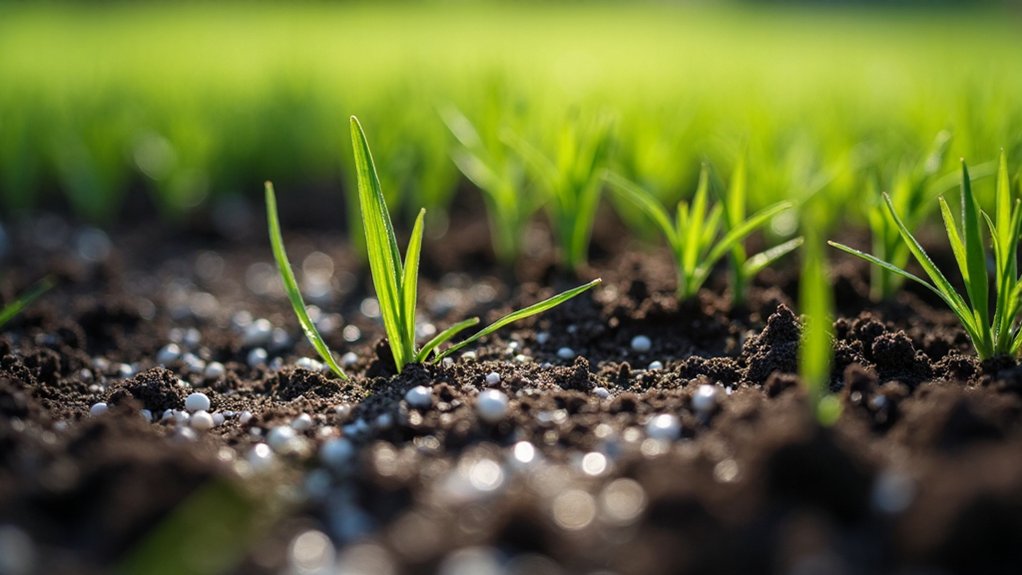
You’ve probably noticed that some overseeded lawns flourish while others struggle, and the difference often comes down to one essential factor: starter fertilizer. When you’re establishing new grass, those tiny seedlings can’t compete with established turf for nutrients, leaving them vulnerable during their pivotal growth phase. The right fertilizer application becomes your seedlings’ lifeline, but there’s a specific science to timing, ratios, and technique that determines whether your investment pays off.
Key Takeaways
- Starter fertilizer provides essential nitrogen, phosphorus, and potassium to support new grass seed germination and early growth.
- Phosphorus is the most critical nutrient, promoting strong root development and helping seedlings establish quickly in soil.
- Cool-season grasses need higher phosphorus ratios like 10-20-10, while warm-season grasses require lower phosphorus around 16-18%.
- Apply starter fertilizer 15-20 days after germination using a spreader for even distribution and optimal nutrient delivery.
- Avoid over-fertilizing which can burn delicate seedlings, and maintain consistent watering to prevent damage to new grass.
Understanding the Role of Starter Fertilizer in Overseeding
Success in overseeding depends heavily on giving new grass seedlings the nutritional foundation they need to thrive. Starter fertilizer serves as this critical foundation, delivering essential nutrients like nitrogen, phosphorus, and potassium directly to new grass seeds during their most vulnerable growth phase. The phosphorus component particularly excels at promoting robust root development, helping seedlings establish quickly in your existing lawn.
When you apply starter fertilizer during lawn overseeding, you’re creating ideal conditions for germination and early growth. This targeted nutrition gives new seedlings a competitive edge over established grass, ensuring they don’t get crowded out. Before application, soil testing helps determine specific nutrient needs, allowing you to select the most suitable starter fertilizer formulation for lasting results.
Key Nutrients That Promote New Grass Germination
Three essential nutrients work together to transform dormant grass seeds into thriving seedlings that’ll establish successfully in your lawn. Phosphorus stands as the most critical nutrient needed for germination, directly supporting strong roots development in your new grass seedlings. Without adequate phosphorus, seeds struggle to establish their foundational root systems.
Nitrogen drives the green, dense growth you want while helping seedlings convert sunlight into energy efficiently. Meanwhile, potassium strengthens your developing grass against drought, weeds, and insect threats during vulnerable establishment phases.
A soil test reveals which nutrients your lawn lacks, helping you choose the right starter fertilizer blend. The best time to apply these nutrients is during seeding, ensuring immediate availability when germination begins and seedlings need nutritional support most.
Choosing the Right NPK Ratio for Your Lawn Type
Understanding which nutrients your grass needs sets the foundation, but selecting the proper NPK ratio makes all the difference in germination success. You’ll want to match your starter fertilizer to your specific grass type for guaranteed results.
Cool-season grasses require different ratios than warm-season varieties:
- Cool-season grasses (fescue, bluegrass): Choose 20-30% phosphorus ratios like 10-20-10 or 16-22-8
- Warm-season grasses (bermuda, zoysia): Select lower phosphorus ratios around 16-18%
- Quick-release nitrogen: Jumpstarts early growth in new grass seeds
- Balanced potassium: Supports overall plant health and establishment
Apply your best fertilizer using a fertilizer spreader after testing soil pH. This guarantees your grass seeds receive the nutrients they need for successful germination and strong root development.
Soil Testing Before Applying Starter Fertilizer
Before you spread any starter fertilizer across your lawn, testing your soil reveals the exact nutrient deficiencies that could sabotage your overseeding efforts. A comprehensive soil test provides detailed information about your soil’s pH, nutrient levels, and overall composition. You’ll discover which essential nutrients are missing and whether your soil conditions need adjustments like lime or sulfur to create the ideal environment for grass seed germination.
Armed with these test results, you can select a starter fertilizer with the precise balance of nitrogen, phosphorus, and potassium your new grass seed requires. Rather than guessing what your lawn needs, you’ll make informed decisions that maximize seed establishment. This targeted approach guarantees your overseeding investment delivers the lush, healthy lawn you’re working toward.
Proper Application Timing for Maximum Effectiveness
While your instinct might tell you to apply starter fertilizer immediately with your grass seed, timing this application correctly makes the difference between thriving seedlings and disappointing results. Starter fertilizer can actually work against your overseeding efforts when applied too early, causing your existing lawn to grow rapidly and shade out vulnerable new seedlings.
Ideal timing strategy for lawn care success:
- Wait 15-20 days after germination before applying any lawn fertilizer
- Allow new seedlings to use their stored seed nutrients during the first two weeks
- Apply pre-emergent herbicide like Tenacity at seeding time instead of starter fertilizers
- Choose a balanced NPK granular fertilizer for the delayed application
This approach prevents your existing lawn from outcompeting new growth while ensuring proper nutrition when seedlings need it most.
Step-by-Step Guide to Applying Starter Fertilizer During Overseeding
Once you’ve determined the ideal timing for your starter fertilizer application, the actual process requires careful attention to detail to maximize results. Begin by selecting a balanced N-P-K ratio like 10-10-10 or 16-8-8 for your starter fertilizer. Load your broadcast spreader according to the product label’s recommended rate, then distribute the fertilizer evenly across your overseeded lawn. Next, incorporate the starter fertilizer into the top 1-2 inches of soil using a rake to guarantee contextually relevant nutrient availability for developing grass seedlings. Avoid over-fertilizing, as excessive amounts can damage emerging seedlings and hinder establishment. Finally, water the area thoroughly after your starter fertilizer application to activate nutrients and promote rapid germination and healthy growth.
Common Mistakes That Can Harm New Grass Seedlings
Although following proper application techniques is critical, many homeowners unknowingly sabotage their overseeding efforts through preventable errors that can devastate new grass seedlings.
These essential mistakes can cause the grass to fail completely:
- Applying too much fertilizer – Excess nutrients burn delicate seedlings and prevent proper root development
- Inconsistent watering schedules – You must water new seedlings lightly but frequently during the first few weeks after planting
- Walking on seeded areas – Traffic compacts soil and damages emerging grass before it establishes
- Using the wrong fertilizer type – Regular lawn fertilizer contains too much nitrogen for vulnerable seedlings
Getting the right amount of starter fertilizer while avoiding these pitfalls guarantees your overseeding investment pays off with thick, healthy grass establishment.
Benefits of Phosphorus for Root Development
Now that you understand what can go wrong during overseeding, let’s examine why the right starter fertilizer formulation makes such a dramatic difference in seedling success.
Phosphorus serves as the powerhouse nutrient for your newly overseeded lawn’s root development. Unlike nitrogen, which primarily drives leaf growth, phosphorus focuses its energy on building robust underground networks. When you apply starter fertilizer rich in phosphorus, you’re giving seedlings the tools they need to establish extensive root systems quickly.
This enhanced root development proves vital during the growing season when your grass faces temperature fluctuations and moisture stress. Strong roots access water and nutrients more efficiently, resulting in your lawn looking healthier and more resilient. Proper phosphorus nutrition during establishment creates the foundation for long-term drought tolerance and overall lawn success.
Watering and Maintenance After Fertilizer Application
The success of your overseeding project hinges on proper watering and maintenance following fertilizer application. After applying starter fertilizer, you’ll need to establish a consistent care routine to support your new grass thrives.
- Water deeply – Provide at least 1/2 inch weekly, maintaining consistent soil moisture without overwatering to prevent fungal diseases
- Monitor growth – Watch for your new grass to reach 3-4 inches before first mowing at recommended height
- Continue to fertilize – Apply balanced, slow-release fertilizer every 4-6 weeks for ongoing development
- Stay vigilant – Monitor closely for weeds, diseases, or insect issues and address problems promptly
Proper watering technique is essential during germination. You want steady soil moisture without creating waterlogged conditions that harm delicate seedlings.
Transitioning to Regular Fertilizer for Established Grass
Once your newly overseeded grass reaches maturity after 6-8 weeks, you’ll need to switch from starter fertilizer to a regular lawn fertilizer with reduced phosphorus content. Regular lawn fertilizers feature balanced NPK ratios like 24-6-12 or 32-4-8, providing more nitrogen for lush green growth and potassium for enhanced drought and disease resistance.
The high phosphorus in starter fertilizer is only necessary during initial overseeding and establishment phases. Continuing with high-phosphorus fertilizer after grass matures isn’t beneficial for long-term lawn health. Shifting to regular fertilizer at the proper time ensures your new grass fills thin areas while maintaining your established lawn’s overall vigor and quality.
Always consult product labels or speak with lawn care professionals to determine ideal timing and application rates for this conversion.
Frequently Asked Questions
Should You Put Starter Fertilizer on New Grass?
You should apply starter fertilizer to new grass for better establishment. Consider lawn aeration importance, topsoil quality impact, grass species selection, irrigation scheduling tips, mowing height preferences, and soil pH optimization for ideal results.
Can You Mix Grass Seed and Starter Fertilizer Together?
Want ideal germination rates? Don’t mix grass seed and starter fertilizer together. This compromises uniform seed distribution and seed to soil contact. Proper overseeding timing requires separate application for effective pre germination preparation.
Will Starter Fertilizer Help Existing Grass?
Starter fertilizer won’t markedly help your existing grass since it’s designed for seedlings. Instead, use balanced lawn fertilizer that spreads evenly on lawn, improves soil quality, and boosts plant vigor for sustained long-term growth.
When Not to Use Starter Fertilizer?
Don’t use starter fertilizer when you’ve got established lawns with adequate nutrients, heavy clay soils that retain fertilizer too long, or when timing’s wrong for your grass type’s growth cycle.
Conclusion
You’ve accessed the secret to lawn success—starter fertilizer isn’t just an option, it’s your overseeding game-changer. You’ll watch bare spots transform into thick, green carpet when you combine the right NPK ratio with proper timing. Don’t let another season pass with disappointing results. You’ve got the knowledge, you’ve tested your soil, and you know the timing. Now it’s time to provide your new grass seedlings the nutrient boost they’re craving for explosive growth.