
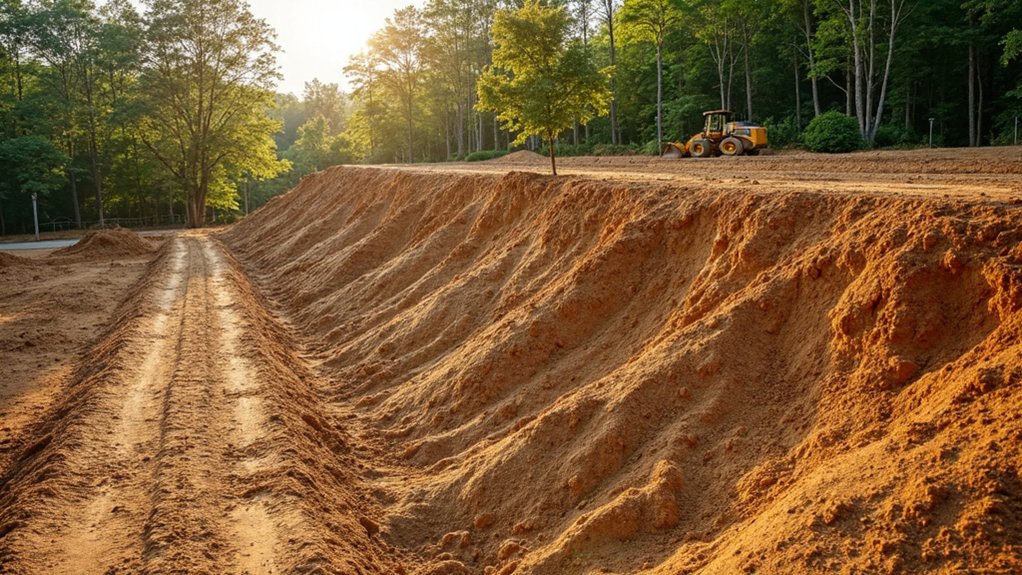
When your landscape project reaches the “finishing touches” phase—that critical seeding step after slope grading—you’re facing one of construction’s trickiest challenges. You can’t simply scatter grass seed and hope for the best on freshly graded terrain. The steep angles, loose soil, and erosion potential create a perfect storm that’ll wash away your investment with the first heavy rain. There’s a specific sequence of steps that separates successful slope establishment from costly do-overs.
Key Takeaways
- Conduct soil testing and apply necessary amendments, then till 2-3 inches and add phosphorus-rich starter fertilizer.
- Choose tall fescue for deep root development and rapid establishment, or perennial ryegrass for quick germination.
- Apply seeds at 4-6 lbs per 1,000 sq ft for cool-season grass, ensuring proper seed-to-soil contact.
- Use hydroseeding, straw mulch, or erosion control netting on steep slopes to prevent seed washout.
- Water lightly daily for 14 days, then transition to deeper watering 2-3 times weekly.
Soil Assessment and Site Preparation After Grading
After wrapping up your grading project, you’ll need to assess and prepare the soil before laying down any seed. Start by conducting an extensive soil test to determine nutrient levels and pH for your new lawn. Based on results, apply necessary soil amendments to create ideal growing conditions. Remove all remaining debris, rocks, and clumps from the graded surface to guarantee smoothness. Till the top 2-3 inches of soil, loosening the seedbed for better seed contact. Apply starter fertilizer high in phosphorus to boost root development in your emerging grass. Finally, lightly rake the surface to create small grooves that’ll hold seeds securely. This meticulous preparation sets the foundation for successful lawn establishment and ensures your new lawns will thrive from the start.
Selecting the Right Grass Species for Sloped Terrain
Which grass species will give you the best results on your newly graded slope? Your success depends on choosing varieties that establish quickly and develop strong root systems to combat soil erosion.
Tall fescue stands out as your superior choice for sloped terrain. Its deep root growth creates an extensive network that anchors soil effectively, while its quick establishment protects vulnerable areas from washout.
Consider these proven options for your new grass seed selection:
- Tall Fescue – Develops robust, deep roots and establishes rapidly on challenging slopes
- Perennial Ryegrass – Germinates quickly to prevent immediate soil erosion while you’re establishing grass
- Annual Ryegrass – Provides fast temporary coverage to keep soil moist and protected during establishment
Match your selection to local climate conditions for ideal long-term slope stabilization and erosion control.
Applying Starter Fertilizers and Soil Amendments
Once you’ve selected the right grass species for your slope, proper soil preparation becomes your next priority for successful establishment. Start by conducting a soil test to determine your soil pH and identify necessary amendments. Based on these results, incorporate organic matter like composted horse manure to improve moisture retention and prevent erosion on your slope.
Apply a starter fertilizer such as ProScape® 21-22-4, which provides essential nutrients through its balanced nutrient ratios and slow-release methylene urea formula. This combination supports rapid root development pivotal for slope stability. Consider using PennMulch® Seed Accelerator, which combines mulch and fertilizer benefits for your grass seeds.
Don’t forget to aerate compacted soil before seeding. Proper lawn care during establishment guarantees your new lawn develops the strong root system needed for long-term slope success.
Seed Application Techniques for Graded Slopes
When seeding graded slopes, you’ll need to apply cool-season grass at 4-6 lbs per 1,000 square feet or warm-season varieties at 8-10 lbs per 1,000 square feet to achieve ideal density. These application techniques will help your new grass seeds establish successfully while providing essential weed control.
- Distribute and rake seeds properly – Use a spreader or hand-broadcast method, then lightly rake seeds into the top 1/4 inch of soil for prime seed-to-soil contact.
- Consider hydroseeding for steep areas – The fiber mulch matrix keeps seeds in place and improves germination rates on challenging slopes.
- Protect with mulch coverage – Apply straw mulch or erosion control netting to hold the soil and prevent seed washout during establishing new grass growth phases.
Establishing Proper Seed-to-Soil Contact
Beyond applying seeds at the correct rates, proper seed-to-soil contact determines whether your newly graded slope will develop into thick, healthy turf. You’ll need to press your best grass seed firmly into the soil surface using a lawn roller or cultipacker immediately after broadcasting. Lightly rake seeds into the top quarter-inch of soil to enhance seed-to-soil contact while avoiding burial too deep. Apply a thin layer of quality topsoil or compost over newly seeded areas to anchor seeds and prevent erosion. This covering also suppresses weed seeds that compete with your grass. If you’re choosing between seed or sod, remember that hydroseeding naturally provides superior seed-to-soil contact through its slurry application method, making it ideal for challenging slope conditions.
Watering Strategies for New Slope Installations
While proper seed-to-soil contact sets the foundation, your watering strategy will ultimately determine whether those carefully planted seeds transform into a thriving slope lawn. The key is maintaining consistent moisture without creating destructive runoff that can wash seeds away from your slope.
Here’s your three-phase watering approach:
- Initial Phase (Days 1-14): Water lightly every day to keep soil consistently moist. Watch for water runs that pool in low spots, adjusting pressure accordingly.
- Transition Phase (After emergence): Gradually shift to deeper watering 2-3 times weekly to establish grass with strong root systems.
- Maintenance Phase: Monitor weather conditions and soil moisture regularly. Increase frequency during hot, dry periods to prevent drought stress while avoiding overwatering that can reduce soil stability and wash newly established grass away.
Implementing Erosion Control Measures
Something as simple as wind or a heavy rainfall can undo weeks of careful seeding work if you don’t protect your slope during the critical establishment period. You’ll want to install erosion control mats over your newly seeded areas to create a protective barrier. These blankets allow grass to start a new growth cycle while preventing soil washout from the top of the soil layer.
Make sure you spread a small amount of straw beneath the mats first – this acts as natural mulch that retains moisture and helps seeds develop a deep root system. Use garden staples to anchor everything securely, especially around your new home’s vulnerable slope areas. Both materials will naturally decompose once your grass establishes itself completely.
Managing Germination and Early Growth
Once you’ve secured your erosion control measures, your attention shifts to nurturing the seeds through their most vulnerable stage. Unlike maintaining an existing lawn, newly seeded slopes require intensive care to establish strong root development in the top inches of soil.
Your germination management strategy includes:
- Water frequently but lightly – Apply 4-6 short watering sessions daily for 2-3 weeks, keeping soil surface moist beneath any layer of straw mulch
- Time your first mowing carefully – Once grass reaches 4 inches, set mower blades to 2-3 inches, removing only one-third of blade height
- Control competition early – Monitor for weed growth and apply selective herbicides when necessary, then introduce starter fertilizer after 4-6 weeks
Restrict foot traffic until grass establishes completely, typically 4-6 weeks post-germination.
Long-Term Maintenance for Newly Established Slopes
After six weeks of careful germination management, your slope moves into a maintenance phase that determines its long-term stability and appearance. Regular mowing promotes dense growth and prevents erosion while establishing deep root systems. Apply slow-release nitrogen fertilizer twice yearly to encourage robust development, especially important for cool-season grasses during their peak growing periods.
Monitor your slope throughout late summer for bare spots where you’ll need to plant grass seed again. Fall overseeding maintains uniform coverage and prevents weed invasion. Annual aeration alleviates soil compaction, improving water infiltration around tree roots and other obstacles without killing the existing turf.
Watch for erosion signs and address issues promptly with additional seeding or mulch. This proactive approach guarantees your growing grass develops into a stable, attractive slope that withstands weather challenges.
Frequently Asked Questions
How to Grow Grass After Grading?
You’ll need proper soil preparation by tilling and fertilizing, then select erosion-resistant seeds like fescue. Apply mulching techniques with straw, install erosion control measures, maintain irrigation requirements, and conduct soil testing importance for successful establishment.
How to Establish a New Lawn From Seed?
After renovating their backyard, the Johnsons successfully established fescue by focusing on proper soil preparation, selecting shade-tolerant varieties, maintaining consistent watering schedules, using appropriate mowing techniques, and implementing frost protection during vulnerable establishment periods.
How to Get Grass to Grow on a Steep Slope?
You’ll need proper soil amendments and seed selection methods for steep areas. Use mulching techniques with erosion control strategies like netting. Implement slope stabilization options and follow consistent irrigation scheduling to establish grass successfully.
How Long Should You Wait to Fertilize After Seeding Grass?
You should wait 4-6 weeks after seeding before fertilizing. This allows proper soil preparation time for seedlings to establish. Apply phosphorus-rich starter fertilizer with ideal fertilizer quantity following your initial watering schedule for optimum weather conditions.
Conclusion
You’ve laid the groundwork for a thriving slope that’ll stand the test of time. Like tending a newborn, your newly seeded grade needs consistent attention during those critical first weeks. Keep watering schedules steady, monitor for erosion, and don’t panic if germination seems slow—good things take time. With proper preparation, the right grass species, and vigilant early care, you’ll soon have a robust, erosion-resistant slope that’s both functional and beautiful.